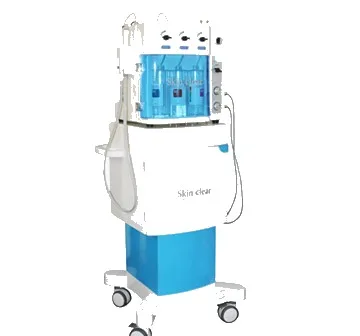
Pmise OJ-01
The OJ-01 is usually the first machine a new therapist is trusted with. Saline, oxygen and serum leave the handpiece as a high-speed mist that clears follicles and leaves the client presentable, which makes it the easiest no-downtime service to slot between laser appointments.
What this platform does
Where the OJ-01 sits on your treatment menu
Treat this one as the utility player in the room. A saline and serum mix is atomised with oxygen and fired at the skin fast — our device manuals put the jet above 200 m/s with droplets in the 50 to 80 micron range — so debris is lifted out of the follicle instead of being scraped off the surface with crystals. No abrasive tips to reorder. No downtime to explain.
Commercially that gap matters. Most clinics that buy a diode or a Q-switched platform end up with the same hole in the diary: what do you sell the client who isn't a laser candidate this month, or the one who just wants a facial that actually does something? This fills it. It also gives a junior therapist somewhere safe to build hands, because a heavy pass here ends in transient redness rather than a burn.
One honest framing note before your marketing goes out. The 2024 American Academy of Dermatology acne guideline concluded that evidence is insufficient to recommend for or against procedural adjuncts such as comedo extraction, peels and device work in acne. So sell this as cleansing, comfort and adherence support beside proper topical or oral therapy — never as a substitute for it. Everything here is operator education, not medical advice.
Technical detail
| Technology | Water + oxygen jet |
|---|---|
| Function | Exfoliation, cleansing, infusion |
| Solution | Saline + serum compatible |
| Downtime | None |
| Applications | Facial prep, hydration, recovery |
| Warranty | 12 months, lifetime maintenance |
How it works
One session, start to finish
Cleanse first. Set your gas and liquid pressure before the client is reclined, not after.
- Pressure. The working range in our documentation is 0.3 to 0.6 MPa. Start at the bottom of it. Climb in small steps and keep asking how it feels — a big jump mid-pass is how you lose a first-timer.
- Grip and distance. Hold the handpiece like a pencil, 45 to 90 degrees to the skin. Around 0.3 to 0.5 cm off the surface when you want a peeling effect; back off to 0.5 to 1.0 cm for a gentler rejuvenation pass, three to five light sweeps.
- Route. Forehead, cheeks, chin, cheeks again, nose, periorbital last. Work diagonally and crosshatch it like weaving, or you will leave stripes that show up in the after photo.
- Protection. Eye shields on. A small pledget in each nostril before you work the nose, tampons in the ears before the jawline. Keep the tip away from the eye, always.
- Endpoint. Blackheads visibly blow out, the skin turns softly pink, and inflamed acne areas can show pinpoint bleeding. That's your ceiling. Read the face and the client and stop — chasing uniform redness is how a good result becomes a complaint.
Intervals, course length and what to package
Single sessions photograph well. Courses are what hold. Our internal documentation is blunt on the point: repeated treatment of the same problem area is necessary. Published work backs that cadence — Jarząbek and Rotsztejn, writing in the Journal of Cosmetic Dermatology, ran five oxybrasion sessions at two-week intervals in 27 women and recorded higher hydration at forehead, cheek and nose after the series, along with a drop in surface pH. A five or six session course a fortnight apart is a defensible package to price around, with monthly upkeep after that.
Screening, aftercare and the calls you should refuse
Screen for broken or infected skin, an active cold sore, and anyone still healing from ablative resurfacing — wait until that skin has re-epithelialised. Go light on genuinely sensitive or reactive skin; over-treatment there is the main cause of an unhappy face at the mirror. Our manuals record adverse events as uncommon and mild: erythema, some swelling, occasional discomfort around the ear or jaw, and small marks that generally settle within two to four weeks. Aftercare is short and non-negotiable: moisturiser, sunscreen, no aggressive actives that night. And anything that looks like an undiagnosed pigmented, ulcerated or fast-changing lesion is a referral for biopsy, not a facial.
Applications and protocol
How it plugs into a laser program
The pairing your therapists will use most is acne. Run the jet for cleansing and comfort between light-based sessions on the acne and acne scars pathway, and let the PE-01 HPT E-light do the inflammatory work. Clients feel progress on the weeks they aren't being pulsed, which keeps them in the course.
Resurfacing is different. Do not jet skin that is still healing from the CF-01 CO2 fractional laser. Wait for the barrier to close, then use the jet as a hydration and comfort step in the weeks that follow. For body-side rooms running the DL-07 diode, the jet is a simple upsell on the face while the client is already in the building — same visit, second ticket, no extra marketing spend.
Beyond acne, the archive lists the same machine being used for dull or rough texture, enlarged-looking pores, seborrhoeic scalp work and folliculitis. Ask your therapists to keep before-and-after shots under fixed lighting; texture claims are hard to sell without them.
Key advantages
Chair time, consumables and training curve
The treatment itself is quick. What sets your slot length is consultation, cleansing and the mask afterwards, so book it like your standard facial and let the machine give you the margin. Consumables stay cheap: saline, whatever serum your protocol calls for, and gas. That last one is where operators leak money. The platform accepts compressed oxygen or plain compressed air, and running air for routine cleansing work saves cylinder cost on the sessions that don't need medical gas.
Training is the real advantage. There are three variables a therapist has to internalise — pressure, distance, speed — and all three are reversible mid-pass. Compare that with teaching fluence and pulse width on a laser, where a mistake shows up as a blister. Most owners can have a new hire delivering a sellable facial far sooner on this than on any light-based device in the room.
Keeping it running
Two faults account for most of the troubleshooting in our service documentation: a blocked water outlet and low output pressure from a kinked or twisted line. Both are prevented by habit rather than by engineering. Drain the residual liquid from the handpiece after each day, clean it, cap it so dust can't sit in the outlet, and check the hoses for leaks before switch-on.
If your room runs a medical oxygen cylinder, treat it with the respect a compressed gas deserves. Oxygen itself doesn't burn, but it makes everything else ignite more easily and burn faster, which is why the VA National Center for Patient Safety hazard summary insists on keeping cylinders away from heat, sparks and ignition sources. Ventilated corner, secured upright, nothing oily nearby. Open the tank only after the line is connected.
Frequently asked questions
How soon after a laser session can we run the jet?
It depends what the laser did. After non-ablative or E-light work, most clinics can schedule the jet within days once redness has settled. After ablative fractional resurfacing, wait until the skin has fully re-epithelialised — jetting a raw barrier is a bad idea and your client will tell you so loudly.
Do we actually need a medical oxygen cylinder?
Not for every session. The system runs on compressed oxygen or on compressed air, and for straightforward deep cleansing the air source is the cheaper choice. Keep the cylinder for the protocols where you want oxygen in the mix, and store it properly.
Will it hurt, and will the client be red afterwards?
It reads as cool and prickly rather than painful. Mild pink is normal and usually short-lived; inflamed acne areas can bleed at pinpoints. Sensitive skin needs a lower pressure and a longer working distance — drop both before you start, not after the first flinch.
What's the fastest way to kill the handpiece?
Leave liquid in it overnight, skip the cap, and let dust dry into the outlet. Do that for a month and you'll be chasing a weak, sputtering spray. A two-minute end-of-day routine avoids it entirely. If you want the service schedule and installation notes for your room, talk to our team before the unit ships.
References
Quote the Pmise OJ-01.
Tell us your country and clinic type. We reply within 24 hours with technical detail, pricing and the spare-parts picture.