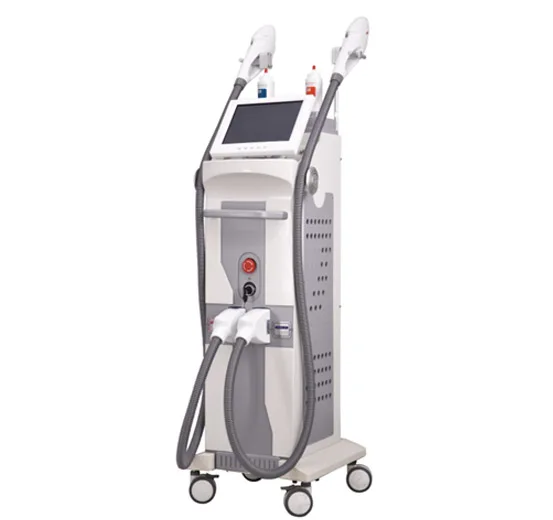
Pmise MF-05
The Pmise MF-05 fires filtered pulsed light and bipolar RF into the same shot, so you can reach a treatment endpoint at lower optical energy. This page is written for the person holding the handpiece, not the person reading a spec sheet.
What this platform does
Most clinics buy an E-light console for one reason. Floor space. One trolley, one trained hand, and the same afternoon can absorb an underarm package, a redness consult and a pigment review without anybody wheeling a second machine down the corridor.
The MF-05 pairs filtered pulsed light across a 480 to 1200 nm filter set with bipolar radio frequency in a single pulse. Light does the selective part. RF does the part light struggles with, because electrical current doesn't care how much melanin sits in the target. Yaghmai and co-authors described exactly this in the Journal of Cosmetic Laser Therapy in 2004: delivering optical and RF energy together reached effective hair reduction at lower optical fluence, safely across skin types.
Set your expectations honestly, though. A big male back covered in coarse dark hair still clears faster on a diode, and that's what the DL-07 is for. E-light earns its keep on mixed-service days and on clients whose hair or skin sits outside the easy melanin window. Everything below is operator education, not medical advice — the licensed clinician in the room owns the final call.
Technical detail
| Wavelength | 480 to 1200 nm (filter set) |
|---|---|
| Technology | IPL + RF (E-light) |
| Filters | Interchangeable, quick-change |
| Cooling | Triple contact cooling |
| Applications | Hair, rejuvenation, pigment, vascular |
| Skin types | Fitzpatrick I to VI |
| Warranty | 12 months, lifetime maintenance |
How it works
What the pulse is actually doing
Light lands first. Melanin in the shaft, or oxyhaemoglobin in a vessel, absorbs it and the target's temperature climbs above the surrounding tissue. Warmer tissue conducts better. So when the bipolar RF follows through the same window, the current takes the path of least resistance and concentrates in the structure the light already flagged. That's the whole trick, and it's why you can back the optical energy off.
Two practical consequences. First, coupling gel isn't optional and isn't cosmetic — it's the conduction path for the RF as well as the optical interface, and our device manuals specify a roughly 2 mm layer applied evenly, never reapplied over a patch you've already fired through. Second, the contact tip's cooling is holding the epidermis down while the dermis heats. Let the tip lose contact and you've removed the only thing protecting the surface.
Filters change the game more than energy does. Drop the cut-off for pigment and vascular work, raise it for hair. Swapping cartridges takes seconds, which is the point of the platform — see the higher-repetition sibling, the PE-01, if your room is running volume hair packages.
Applications and protocol
One session, start to finish
Consult before you touch anything. Skin problem, pain tolerance, what's in the diary next week, what the client actually expects. Screen for contraindications here, not at the couch. Photograph and file with a signature — you will want that photo at session four when somebody says nothing has changed.
Then: pick the handpiece, cleanse the area, shave hair-removal zones down to a short 1 to 3 mm stubble, power up, lay the gel, goggles and eye patches on both operator and client for any pulsed-light work. RF-only passes don't need eyewear, but they do need every piece of metal jewellery off the client.
Test before you treat. Our archived operating procedure has you fire two low-energy flashes on the inner forearm, then wait and read the response. You want warmth, not a sting. From there you climb — small steps, no more than about 2 J at a time, asking after every change, firing a couple of shots after each parameter change before you go back to the treatment zone. Overlap each spot by roughly a third. On RF passes, an infrared thermometer keeps you honest: the same manuals put the useful surface band in the low-to-mid 40s Celsius.
Spacing, course length and what that means for the till
Hair is a growth-cycle problem, so sessions have to be spaced. Sadick's 18-month follow-up of combined RF and optical epilation used four treatments at 8 to 12 week intervals and reported an average clearance around 75 percent at 18 months across skin types and hair colours. That's the number to build a package around — four visits minimum, spread over most of a year, with top-ups after.
Pigment, redness and rejuvenation run differently. Our engineering archive describes courses of roughly 3 to 5 sessions, and it's blunt about the rule between them: every reaction from the last pass has to have settled before you fire again. Crusting still lifting? You wait. Sell the course up front and the waiting stops feeling like a lost booking.
Throughput is where the machine pays for itself. The console needs a few seconds between discharges, so an underarm pair is quick and a full lower leg is not. Build your price list around that gap rather than around a per-shot fantasy. Consumables stay cheap — gel, gloves, eyewear — but the lamp is a wear item, and a busy hair room burns through lamp life faster than a facial-led room does. Ask us for the replacement schedule on Service before you set your pricing.
Key advantages
Where it earns its place, and where it doesn't
- Three price lists from one bay. Hair packages, freckle and pigment courses, superficial vascular work and photorejuvenation all come off the same trolley. Filter swap between clients, not a new machine.
- Lower optical fluence for the same endpoint. The RF contribution is what lets you treat Fitzpatrick IV and V without pushing light energy into the danger zone, and what gets you a result on hair that's gone light or fine.
- Triple contact cooling. One less variable for a junior technician to get wrong.
- Training curve is real but short. Anyone who can already run an IPL handpiece picks this up in days. The RF side is where they slip, because it's a second energy dial with its own endpoint. Budget supervised sessions and a written parameter log for the first month.
- It has limits. Not a tattoo device — that's the QN-03. Not a deep vascular device either; leg veins want the 1064 nm long pulse of the LN-01. Buying an E-light to do everything is how clinics end up disappointed in it.
Frequently asked questions
How many sessions before a client sees real hair reduction?
Plan on four spaced treatments before you judge anything, following the 8 to 12 week interval used in the published combined RF and optical follow-up work. Clients notice thinning earlier, usually after two. Say that out loud at the consult, because the mismatch between session two and session four is where refund conversations start.
Who should I turn away?
The screening list in our device documentation is short and non-negotiable: anyone on photosensitising medication such as tetracyclines; any lesion without a firm diagnosis; pacemakers or similar implants; poorly controlled diabetes, hypertension, heart disease or epilepsy; anticoagulant use within the past two weeks; keloid tendency; pregnancy; and skin that's been sunburnt or freshly tanned. An undiagnosed pigmented lesion goes to a dermatologist for assessment or biopsy, never under the handpiece.
What do I do when a client hyperpigments afterwards?
Post-inflammatory hyperpigmentation is the classic darker-skin complication and it's usually a parameter confession. The correction our manuals give is consistent: widen the pulse width, lengthen the pulse delay, drop the fluence, and lengthen the gap before the next session. Strict sun avoidance in between. Most temporary darkening and micro-crusting settles inside a week or two — persistent change needs a clinician's review, not another pass.
Does hair ever grow back thicker after treatment?
Occasionally, yes, and it's worth mentioning in your consent form. A 2021 systematic review and meta-analysis by Snast and colleagues in the American Journal of Clinical Dermatology put pooled paradoxical hypertrichosis at around 3 percent across laser and light hair removal — but almost entirely on the face and neck, at roughly 0.08 percent elsewhere. Body work carries very little of this risk.
Can one technician run the room alone?
Yes, and most do. What they can't do is run it alone without a parameter log. Record skin type, filter, energies and the client's reported sensation every session — it's how the next operator picks up the case, and it's your defence if anything goes wrong. Pair the platform with the broader wavelength strategy on our hair removal solutions page when a client's hair type outgrows what E-light does well.
References
- Yaghmai D et al. Hair removal using a combination radio-frequency and intense pulsed light source. J Cosmet Laser Ther, 2004.
- Sadick NS et al. Hair removal using a combination of conducted radiofrequency and optical energies - an 18-month follow-up. J Cosmet Laser Ther, 2004.
- Snast I et al. Paradoxical Hypertrichosis Associated with Laser and Light Therapy for Hair Removal: A Systematic Review and Meta-analysis. Am J Clin Dermatol, 2021.
Quote the Pmise MF-05.
Tell us your country and clinic type. We reply within 24 hours with technical detail, pricing and the spare-parts picture.