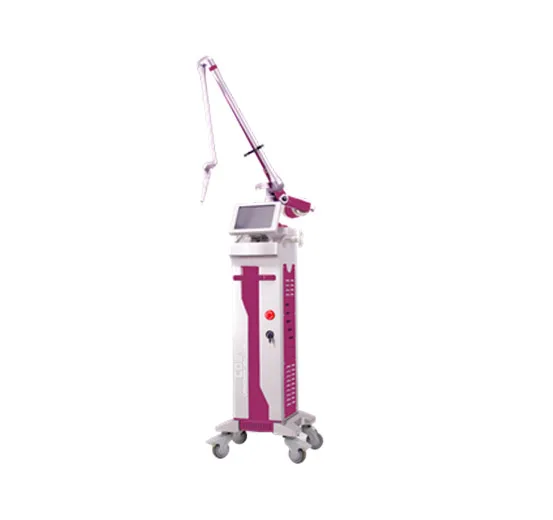
Pmise CF-01
An ultrapulse CO2 fractional platform is only as good as the protocol around it. Here is how the CF-01 gets run in a working clinic: screening, parameter starting points, how many passes, when to stop, and the aftercare fortnight that decides whether the patient rebooks.
What this platform does
Buying a CO2 fractional platform is the easy part. Running it well is where a clinic either builds a real scar-revision practice or quietly parks the console in a back room. So this page is the operator's view of the CF-01: what a session looks like, how many passes you dare take, and what your front desk needs to understand before it books anybody.
Three emission modes sit behind one foot switch. Continuous, ultrapulse, fractional. Almost all of your aesthetic revenue comes from fractional mode; the other two are there for focused, deeper work under a physician. Our device manuals for this platform describe the fractional output as a randomly scanned pattern of micro-columns, deliberately spaced so intact skin is left between them.
That spacing is the whole commercial argument. Intact skin between the columns means faster re-epithelialization, which means downtime you can honestly quote, which means the patient comes back for pass two instead of writing a review.
Where it sits next to your other machines
Reach for CO2 when the target is textural and deep: atrophic acne scars, surgical and burn scars, coarse photodamage. If the patient has darker skin, hates downtime, or is simply nervous, the non-ablative EF-01 1550nm fractional laser is the safer sell even though it needs more sessions. Both belong in a clinic that markets scar treatment seriously. Neither one replaces the other.
Technical detail
| Wavelength | 10600 nm |
|---|---|
| Laser type | Sealed CO2, RF-excited |
| Emission modes | Ultrapulse, Pulsed, CW |
| Output power | 1 to 30 W |
| Spot size | 0.1 to 2.0 mm |
| Cooling | Air-assisted + optional chilled tip |
| Warranty | 12 months, lifetime maintenance |
How it works
Water is the target; heat is the by-product you manage
At 10600nm the energy is absorbed by water in soft tissue, not by pigment. Each focused spot vaporizes a narrow column and leaves a rim of coagulation around it. Our engineering archive for this platform puts that micro-channel at roughly 0.12mm across, reaching two to four millimetres down — deep enough to reach the layer where sun-driven elastosis actually lives.
Random scanning matters here. Because the spots are laid down out of sequence rather than in a marching line, each one has time to cool before its neighbour fires, and heat doesn't pile up across the field.
After that the wound-healing cascade does the work: inflammation, proliferation, remodeling. New collagen fills the framework over weeks, not days. Tell patients that at consultation. They will judge you at week two and thank you at month three.
Density, area and proportion: the three dials that set your downtime
Pattern area, spot density and the proportion between them decide how much of the treated field you ablate. Push density up and you get more correction plus a longer, angrier recovery. Ease it down and you get a gentler result the patient tolerates. Pulse width is adjustable as well, which lets an experienced operator chase collagen contraction without dumping surplus heat into the surrounding tissue.
Overlap is the mistake that costs you money. Patterns must not overlap, and the overlap between beams inside a pattern should be minimal — our manuals are blunt that excessive overlap produces confluent thermal necrosis, deeper wounds and eventually scars.
Applications and protocol
Before anyone fires a shot
Screening comes first, and it isn't a formality. Keloid or hypertrophic scarring history, scleroderma and collagen vascular disease, ongoing immunosuppressants, past radiotherapy or deep resurfacing over the same area, active herpes simplex, psoriasis, severe eczema, vitiligo, poorly controlled diabetes and pregnancy all sit on the contraindication list in our device manuals. Photograph front, side and oblique. Get consent signed before the appointment, not after it.
Then the routine. Cleanse and dry the area properly, because leftover surface water steals energy from where you want it. Disinfect the tip. Apply topical anesthetic under occlusion for roughly 30 to 60 minutes. Goggles on the patient, eyewear on everyone else in the room — this is a Class 4 laser, and the US FDA states plainly that Class IIIb and IV products give ready access to radiation capable of injuring eye and skin. Warm the machine up, fire a test on the black test card, then run a low-energy test patch on the inner forearm and ask the patient what they feel.
Working the face, pass by pass
Start at the forehead. It tolerates energy well and gives you a read on the patient before you reach anywhere delicate. Mild photodamage or light scarring often needs one pass only. Moderate cases take two: wipe away the dry debris between passes, then repeat. Severe cases earn a third pass only on the zones still asking for it, usually glabella, perioral and mid-cheek.
Stop conditions are simple, and every technician should have them memorized. Stop when the wrinkle or scar has clinically gone. Stop when tissue turns yellow-brown, because that is thermal necrosis talking. Stop when you see no further tightening. Three passes is the ceiling anywhere on the face; the jawline gets one; eyelid skin gets no more than two, at reduced density, and you treat the cheek before you go near the orbit.
Treat the whole cosmetic unit rather than a patch. A visible demarcation line is close to unfixable afterwards, and it's the complaint that ends up in front of a lawyer.
Aftercare is what patients actually grade you on
Edema peaks around day two or three and mostly settles by day five to seven. Cool the area, keep it elevated, and follow whichever wound protocol your physician prefers: open care with soaks and continuous occlusive ointment, or a closed dressing applied within about two hours of treatment, changed daily and off within three days. Strict photoprotection is non-negotiable for months, not weeks.
Book the follow-ups while the patient is still in the chair — day 1, day 3, week 1, week 3, week 6, month 3. Itching in the second week is common, but it should trigger an infection check rather than a shrug. New or persistent pain, spreading patchy redness, yellow exudate or pustules on day two or three means you escalate to the treating physician the same day. Once the surface has closed, a water-oxygen jet makes a gentle rehydration step that patients enjoy and that fills a low-risk appointment slot. Everything here is operational guidance for trained staff, not medical advice; treatment decisions belong to a qualified clinician.
Key advantages
What you actually get for the chair time
Chair time is dominated by anesthesia, not by lasing. That 30 to 60 minute occlusion window means CO2 wants a proper appointment block, not a slot squeezed between two facials. Is that a lot of room time? Yes — price accordingly, and use the numbing period for photography, consent and the parameter record. Two treatment rooms sharing one console is the oldest throughput trick there is.
Consumables stay thin. No gel, no per-shot cartridge. You're buying anesthetic cream, gauze, dressings and eye protection. Recurring cost lives in optics care and in keeping the room clean, because dust is a genuine enemy of a precision optical system. Every unit ships with a 12-month warranty and lifetime maintenance support, and our service team trains your staff on installation.
Worth pricing in too: this console is not a one-indication machine. Fractional mode carries skin resurfacing and acne scar work, while ultrapulse and continuous modes hand a physician a focused cutting and vaporizing tool. Three revenue lines, one footprint, one training curve.
Frequently asked questions
How many sessions, and how far apart?
It depends on the indication and how hard you treated. Mild texture work is often a single round. Moderate to severe scarring usually needs a series. Don't re-treat on a calendar — re-treat when the skin says it's ready: erythema settled, no crusting, no sign of infection. Since our own follow-up schedule runs out to the three-month review, plan a scar course in months rather than weeks and say so at consultation, so nobody arrives expecting a fortnightly cadence.
Can we treat a patient who has been on isotretinoin?
The old blanket six-month rule has softened. A 2017 American Society for Dermatologic Surgery task force led by Waldman, published in Dermatologic Surgery, found insufficient evidence to justify delaying non-ablative and fractional ablative procedures in patients currently or recently exposed to isotretinoin, while fully ablative resurfacing and mechanical dermabrasion stayed off the recommended list. That's a documented call for the treating physician, not a front-desk policy. Our own manuals still flag recent retinoid use as a caution.
Is it safe on Fitzpatrick IV to VI?
Fractional is far kinder than full-field ablation here, but kinder isn't risk-free. A small early series by Tan and colleagues in the Journal of Drugs in Dermatology (2008) reported no post-inflammatory hyperpigmentation in seven patients of skin types IV and V treated with a fractional CO2 device — encouraging, though seven patients is seven patients. Pigment change remains the complication that darker-skinned patients most often see after CO2 work. In practice: lower density, fewer passes, obsessive sun avoidance, and an honest conversation. If pigment risk worries them, route them to the 1550nm option instead.
How long before a new technician runs it alone?
Longer than for intense pulsed light, and you should budget for that. The mechanical part — pattern, area, density, foot switch — takes an afternoon. Reading tissue response takes months. Recognizing the yellow-brown endpoint, knowing when to stop, feathering the edge of a treated zone so it blends into untreated skin: none of that comes from a slide deck. Pair a new operator with an experienced one for their first courses and keep the parameter record for every patient. Those records are your training curriculum.
References
- Waldman A, et al. ASDS Guidelines Task Force: Consensus Recommendations Regarding the Safety of Lasers, Dermabrasion, Chemical Peels, Energy Devices, and Skin Surgery During and After Isotretinoin Use. Dermatol Surg, 2017
- Tan KL, et al. Low risk of postinflammatory hyperpigmentation in skin types 4 and 5 after treatment with fractional CO2 laser device. J Drugs Dermatol, 2008
- US FDA - Frequently Asked Questions About Lasers (laser hazard classes and Class IIIb/IV risk)
Quote the Pmise CF-01.
Tell us your country and clinic type. We reply within 24 hours with technical detail, pricing and the spare-parts picture.