Skin resurfacing
Resurfacing carries one of the highest ticket prices on a clinic menu, and one of the heaviest servicing costs per case. Get the aesthetic unit, the pass count and the aftercare kit right and one room carries the month.
What you are treating
Every resurfacing enquiry that walks through the door is really three jobs wearing one word. Texture — roughness, open pores, etched lines, old acne damage — is an ablation job. A softening jawline is a heating job. Blotchy colour is a pigment job. Most faces arrive with some of each, and a consult that never separates them sells the wrong machine time and disappoints everybody.
Grade the photoaging before you quote anything
Our CO2 resurfacing handbook grades wrinkling in three bands, and it's still the fastest triage a consult room can run. Type I is mild: subtle structural change, fine lines you have to angle the light to catch. Type II sits in the middle — obvious papular elastosis, some discolouration, a moderate wrinkle count. Type III is the heavy end: thickened, yellowed, confluent elastotic tissue, deep folds, skin gone quadrangular. The same handbook lists thinning, fragility, coarse texture and enlarged pores alongside those bands.
Type I buys a light course on a non-ablative platform and a client who goes back to work tomorrow. Type III is ablative work, genuine downtime, and an experienced hand on the footswitch. Sell those two the same package and you'll meet both of them again in the complaints file.
The cosmetic-unit rule, and what it does to your price list
Here's the constraint nobody prints in a brochure. Our handbook is blunt about it: resurface the whole aesthetic unit or you leave a visible line where treated skin meets untreated skin, and that line is close to impossible to remove afterwards. Lower lid, upper lid and upper lip can stand as units of their own. Anything else smaller than a full face is to be avoided.
So "can you just do my crow's feet with the CO2" has an honest answer, and it isn't yes. Price ablative resurfacing per face. Route the client who only wants one zone to a non-ablative or RF pathway instead, where the transition into untreated skin is forgiving.
What follows is operational reference for clinic owners and their teams, not medical advice. Diagnosis, patient selection and treatment decisions belong to a qualified practitioner working under local regulation.
How the treatment works
What the grid is doing while your technician watches the timer
A fractional pass drills a field of microscopic columns and deliberately leaves living skin standing between them. Manstein and colleagues set out that principle in Lasers in Surgery and Medicine back in 2004, and every fractional console on the market since is a variation on it. Our internal light-tissue notes add the part that actually decides your settings: around each column sits a rim of coagulated tissue, and pulse width governs how thick that rim gets. Let the rims bridge into one another and you have stopped treating fractionally. You've made a continuous burn, and it heals as scar.
Which is why the two front-panel dials matter more than the wattage on the spec sheet.
Density and energy: coverage versus depth
Density is how much of the field you injure. Our device documentation for the CF-01 CO2 fractional laser steps it at 6x6, 12x12 and 24x24 spots per square centimetre, with pulse energy adjustable in 2 mJ increments across a 2 to 200 mJ range. Energy is how deep each column goes. High density plus low energy gives a shallow, wide treatment and more surface downtime. Low density plus high energy reaches deeper damage while leaving more intact skin as a healing reservoir.
Teach operators to move energy zone by zone and leave density alone until they've run a few dozen faces. Density is the dial that quietly turns a fractional pass into a full ablation.
Ablative or non-ablative is a calendar decision, not an ambition one
Ask what week the client can afford to lose. The StatPearls review of ablative laser resurfacing puts re-epithelialisation after CO2 treatment at roughly eight days, with erythema persisting about two weeks after fractional work — against weeks to months for an aggressive full-field resurfacing. It also puts the realistic time off work after fractional CO2 at four to ten days.
Non-ablative 1550 nm work never breaks the surface, so the recovery conversation is a different one entirely: redness for hours, makeup the next day, results that accumulate across a course rather than landing in one dramatic week. Neither route is the better machine. They serve different diaries.
A realistic treatment protocol
Screening that cancels the booking
Screening isn't paperwork, it's your insurance. Our handbook lists recent isotretinoin use for photoaging within the past one to two years, hypertrophic or nodular scarring tendency, scleroderma and collagen vascular disease, ongoing immunosuppressants, a history of radiotherapy or deep chemical resurfacing over the same field, burn scarring, active herpes simplex, psoriasis, severe eczema, vitiligo, serious cardiovascular disease, hypertension, diabetes and pregnancy. The StatPearls review is stricter still on the retinoid question, citing traditional teaching of six to twelve months off oral isotretinoin before resurfacing, and it describes antiviral prophylaxis started the day before or the morning of the procedure. Photograph front, side and oblique under the same light every visit. Month three is exactly when a client forgets what they looked like.
The numbing block is your real bottleneck
Do the room maths before you build the price. Ablative work loses thirty to sixty minutes to topical anaesthetic under an occlusive film before the laser is switched on, and that occlusion hydrates the skin, which changes how it takes the laser. Our erbium glass operating notes run twenty minutes of topical for non-ablative work, then a full face in roughly 1.3 to 2 hours.
Add it up. One ablative full-face case eats a morning and a room. Quote off laser time alone and you underprice it every single time.
Which platform gets this face
The pass-by-pass mechanics of an ablative session — test card and forearm patch, forehead first, the mild / moderate / severe pass structure, the jawline and eyelid limits, the no-overlap rule and the stop conditions that cap the whole thing at three passes — are written out on the CF-01 page, and there is no sense running them twice. The call that belongs here is the one taken before any of that: which console the face gets booked onto.
- CF-01, one ablative session: Type III photoaging, deep textural damage or scar tissue, and a client who can genuinely surrender the recovery window and accept whole-unit pricing.
- EF-01, a course: Type I to II change, a diary with no week spare in it, a nervous first-timer, or a face where pigment risk argues for leaving the epidermis intact.
- RF-01 alone: the complaint is laxity rather than texture or colour, or the client wants one zone only — no wound edge means no demarcation line to blend.
One consult step belongs to every route. Run a skin elasticity recoil test before anything is planned near the lower lid, because over-tightening lax skin there is how ectropion happens.
Aftercare is a product line, not a leaflet
Our handbook is emphatic that a closed dressing beats an open wound: it speeds re-epithelialisation by 30 to 45 percent, softens pain and inflammation, produces a milder scar and gets new collagen forming about three days sooner than an open face. The application window and change schedule sit on the CF-01 page; once the dressing is done, cool 0.25 percent acetic acid soaks and continuous emollient. Six follow-up contacts are scheduled across the first three months. Build those into the package price. A client who paid for the follow-ups shows up for them.
The complication calendar your team should know cold
The first-week wound timeline is on the CF-01 page; the entries that cost you money fall later. Itching in the second week is not "healing" — treat it as an infection flag, candida in particular, and get the client seen. Pigment is the risk that decides your reviews. A 2023 review in Dermatology Reports by Bin Dakhil and colleagues pooled fourteen trials covering 313 patients and reported that a post-operative topical anti-inflammatory regimen lowered PIH incidence; interestingly, Fitzpatrick phototype on its own didn't predict who got it. But 313 pooled cases won't retire caution by phototype. Fitzpatrick IV to VI still start on a test spot at low density and earn more at review, same as the EF-01 page says — conservative settings and strict sun avoidance either way.
The one that catches clinics out is hypopigmentation, because it turns up six to twelve months later — long after everyone stopped worrying. Our handbook ties it to spot overlap above fifty percent and to more than three scans. That's your refund window. It's also why the no-overlap rule and the three-pass ceiling are worth enforcing on a technician who thinks they're being generous.
Choosing between the platforms
Three platforms, three business models
The CF-01 at 10600 nm is the heavy tool. One console covers the deep columns a scar needs and a light full-face pass, so one treatment room doesn't have to hold two machines. It buys the biggest single-session change and drags the whole downtime apparatus along — dressings, follow-ups, and a diary that can absorb a morning per case. Type III photoaging, deep textural damage and scar work live here.
The EF-01 at 1550 nm is the volume machine. Non-ablative and surface-intact, so downtime stays minimal and darker skin stays workable — though on Fitzpatrick IV to VI it is a test spot and low density first, never a full face on day one. It sells as a course: predictable revenue, lighter consent conversations, a client who books Thursday and goes out Saturday.
The RF-01 isn't a resurfacing machine at all and shouldn't be sold as one. Bipolar radio frequency heats the dermis without a chromophore, so it works across every skin type and treats laxity — the complaint that resurfacing keeps getting blamed for not fixing. Pair it with either laser and you can answer both halves of an ageing face without over-treating either.
The course numbers, straight from the operating notes
Our 1550 nm course sheet is specific, and specificity is what lets you package properly. Dry, rough skin: about two to four sessions at five to seven day intervals. Uneven tone: two to three sessions at the same spacing. Energy sits in a 30 to 40 mJ band with topical anaesthetic, and the endpoint the operator is looking for is mild erythema plus a tightening sensation, not blanching. Straight after the pass, concentrated serum, twenty minutes until the heat and redness settle, then a hydrating mask for twenty minutes, then sunscreen. No foundation for twenty-four hours, hands off the face for the first hour.
Our seven-zone facial parameter set for the same platform is what a new hire should study: energy is graded zone by zone, pulled right down around the eye and nose, pushed up on repeat regions. Four different settings on one face in one session — that's the argument for an adjustable console over a preset one, and for training staff properly.
Staffing, training and the sequence around the laser
Think of your team in three tiers. RF and the OJ-01 water oxygen jet are junior-friendly — the jet earns its place as the cleansing step before a session and the soothing step after. The carbon peel mode on the QN-03 is the answer for a client who wants pore and oil refinement with no downtime at all, and it books in a lunch hour. Non-ablative fractional needs a trained operator working to a written protocol. Full-face ablative resurfacing sits at the top and, in most markets, at physician level. Check what your regulator actually permits before you build a rota around it.
Sequence matters too. Settle active disease first, then resurface — running a fractional laser across inflamed skin invites the exact complication you spent the consult avoiding. Our acne page covers that order, and melasma deserves its own cautious pathway rather than a resurfacing pass. If you want the installation, training and spare-parts picture before you commit a room, our service page lays it out.
Recommended equipment
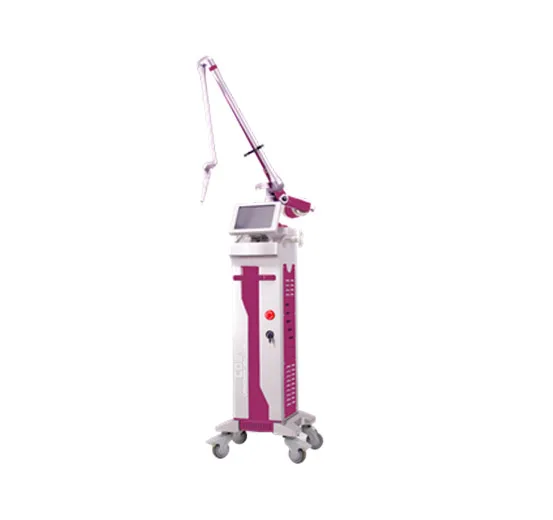
CF-01
10600nm ultrapulse CO2 fractional laser for scar revision, resurfacing and rejuvenation.
View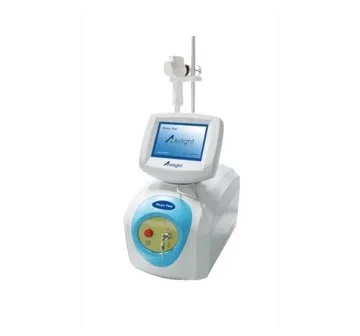
EF-01
1550nm non-ablative fractional laser for acne scars, fine lines and stretch marks.
View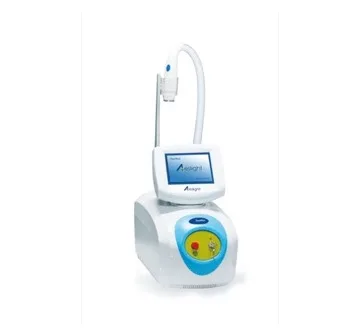
RF-01
Bipolar RF for skin tightening, lifting and wrinkle reduction across face and body.
ViewFrequently asked questions
How many resurfacing clients can one room actually turn over in a day?
Fewer than the brochure implies. Take the ablative case: thirty to sixty minutes of occluded topical anaesthetic, the treatment itself, then photography, dressing and an aftercare briefing that has to be delivered properly rather than handed over on paper. That's a morning. Non-ablative is kinder but not fast either — count on the better part of two hours a face once the topical is on. Build the day around two ablative cases at most, or stack non-ablative courses and keep the ablative machine for booked-in-advance slots.
Can we sell resurfacing on just one zone of the face?
Not with an ablative laser, no. Our handbook treats the aesthetic unit as the minimum treatment area, because a partial pass leaves a demarcation line between treated and untreated skin that the client will notice forever and you will struggle to fix. Lower lid, upper lid and upper lip are the recognised exceptions. If somebody wants one zone only, route them to non-ablative fractional, RF or a carbon peel, where the edges blend.
How long before a new technician can run this unsupervised?
Longer on the ablative side than any distributor will tell you, and it isn't really about button pressing. The skill is reading tissue: knowing when contraction has stopped, spotting the yellow-brown change that means thermal necrosis, and having the discipline to stop at three passes when a client asks for more. Start people on RF, oxygen jet and non-ablative work under a written protocol. Let them near the CO2 only once they can predict what the skin will do before they fire.
What do we offer the client who cannot take any downtime?
Be honest that they're buying a different result, then sell it well. Non-ablative 1550 nm across a course, RF for laxity, a carbon peel on the QN-03 for pores and oiliness, the oxygen jet for immediate brightness before an event. Improvement accumulates instead of arriving in one week. Clients who understand that up front tend to complete courses; clients who were promised ablative results from non-ablative sessions tend to ask for money back.
Where do clinics actually lose money on resurfacing?
Three places, reliably. Underpricing, because they costed the laser time and forgot everything wrapped around it. Count the stack before you set a price: thirty to sixty minutes of occluded numbing, six scheduled follow-ups, the occlusive film, saline gauze for the wipe-down, closed dressings at one change a day for up to three days, then the 0.25 percent acetic acid soaks. Machine-side upkeep and spares sit on our service page. Over-treating, because an operator chased a result past the stop conditions and bought a pigment complication that surfaces months later. And under-consenting, because nobody explained that erythema after fractional CO2 runs to about two weeks. None of those are equipment problems. All three are protocol problems, which is the good news, since protocols are cheaper to fix than machines.
References
- Ablative Laser Resurfacing - StatPearls, NCBI Bookshelf (re-epithelialisation and erythema timelines, isotretinoin interval, antiviral prophylaxis, recovery time after fractional CO2)
- Bin Dakhil A, Shadid A, Altalhab S. Post-inflammatory hyperpigmentation after carbon dioxide laser: review of prevention and risk factors. Dermatol Reports. 2023.
- Manstein D, Herron GS, Sink RK, Tanner H, Anderson RR. Fractional photothermolysis: a new concept for cutaneous remodeling using microscopic patterns of thermal injury. Lasers Surg Med. 2004;34(5):426-438.
Build a treatment bundle.
Get a quote for the machines behind this solution, configured to your clinic and market.