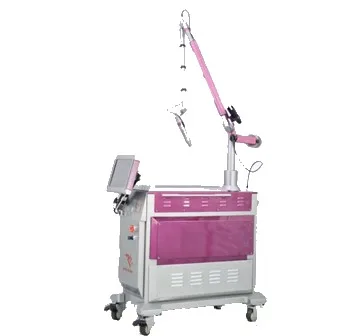
Pmise QN-03
Tattoo ink, stubborn pigment and carbon peel all come off the same handpiece here. This page is about how your technician runs it on a full day, not what sits on the spec sheet.
What this platform does
Three appointment types share one console, and that is why a QN-03 ends up in a treatment room: tattoo work, epidermal and dermal pigment, carbon peel. Each asks something different of the operator.
The Q-switch is passive: a fixed nanosecond pulse, no electro-optic timing to drift. The trade is on the energy side — this platform climbs above single-pulse output by stacking pulses rather than by fine shot-to-shot metering. For high-volume tattoo clearance with granular control over every shot, look at the EO Q-switched platform instead.
One warning: this machine costs clinics money through operator confidence, not faults. The energy range that clears a black tattoo will wreck a melasma face.
Technical detail
| Wavelength | 1064 / 532 nm |
|---|---|
| Q-switch | Passive |
| Special mode | Carbon peel |
| Spot size | 1 to 6 mm |
| Energy | 400 mJ single pulse, 800 mJ double, 1200 mJ triple |
| Pulse width | 6 to 8 ns |
| Frequency | 1 to 5 Hz |
| Applications | Tattoo, pigment, carbon peel |
| Warranty | 12 months, lifetime maintenance |
How it works
Pick the wavelength before you touch the energy
Two outputs, two jobs. 1064nm handles black, blue and green-blue ink and reaches pigment sitting in the dermis; 532nm takes red; the two together deal with coffee and brown shades. Our device manuals put it that plainly. Green-blue and teal shift on 1064; true green often wants 694nm or 755nm, which this platform does not carry. Say that at consultation.
Dry the skin first. Moisture bleeds energy away before it reaches the target, and our technical documentation names it as a direct cause of a flat result. Hold the tip perpendicular to the surface, overlap each spot by roughly a third, and keep the beam off normal skin. Eyewear on everyone before the first shot — see screening below.
Know the energy ladder before you read any protocol
This is a single-lamp, twin-rod build, and the archive is specific: up to 400mJ on a single pulse, up to 800mJ on a double, up to 1200mJ on a triple. You climb past 400mJ by stacking pulses, not by pushing one pulse harder, so single to double is a jump, not a nudge — run fresh test shots on both sides of that step. The archive publishes ceilings, not an increment table, and every mJ figure below comes from indication sheets for this family of Q-switched machines, so check what your own console dials in and round to the nearest setting it offers.
Starting energies, and the endpoint that tells you to stop
Every protocol in the archive opens the same way: three to five test shots at a low setting, then read the skin.
One rule before the numbers: mJ is not a dose. The same 200mJ is a different treatment at every aperture — the four starting points below span roughly eightfold in J/cm². Records and handovers carry mJ and spot, or they are worthless.
- Melasma and general hyperpigmentation — 1064nm at 6mm, the widest aperture this machine has, so energy is your only lever. Start around 200mJ, roughly 0.7 J/cm² at 6mm. Stop when the area turns light red. Bleeding or a whitened patch means you overshot; our manuals are blunt about the consequence: serious pigmentation afterwards.
- Zygomatic macules — 1064nm, spot above 4mm, from about 200mJ. Same number on the dial, but at 4mm that is roughly 1.6 J/cm², over twice the melasma dose. Stop at slight ooze.
- Nevus of Ota or Ito — 1064nm, spot at least 3mm, starting nearer 400mJ: roughly 5.7 J/cm² at 3mm, eight times the melasma figure off the same console. 400mJ is also this platform's single-pulse ceiling, so going higher means switching to double-pulse and re-testing. These lesions sit deep and need the energy; too little and the pigment never fragments.
- Cafe-au-lait macules — 532nm on lighter phototypes, 1064nm from type III upwards, spot at least 3mm, around 200mJ, endpoint light red. The sheet sets a floor, not a size, so your aperture is the dose — 200mJ is roughly 2.8 J/cm² at 3mm and 0.7 J/cm² at 6mm. Record which you used.
Treat those as internal starting points, not prescriptions; your supervising physician and local clinical rules outrank this page.
Spot size is a depth control
The aperture range here runs 1mm to 6mm. At the same energy density, a wider spot reaches deeper, because proportionally less light scatters away at the edges. Dermal pigment therefore wants something above 2mm, and our archive reserves the narrow end — under 2mm — for junctional naevi and scars. Narrowing the spot to be gentle quietly makes the beam shallower and hotter.
Applications and protocol
Screening, and the list you keep on the wall
The hard stops from our device manuals: cardiac pacemakers or implanted defibrillators, functional cosmetics used within the past month, severe diabetes, hypertension, heart disease or epilepsy, vascular surgery on the treatment area inside the last two months, broken skin, active herpes, malignant lesions or existing scarring in the field, and pregnancy. Anything that looks like a lesion rather than a blemish goes to a physician for assessment, possibly biopsy, before a laser goes near it.
Before every shot, the operator and everyone else in the room — client included — wears eyewear rated across 200 to 1080nm. This console fires 1064nm and 532nm, so a lens cut for one output leaves the other wide open. 532nm is visible green light, and staring into the output risks keratitis or worse corneal injury. Our device manuals are explicit. Warning sign on the door too.
In the consent form: cosmetic tattoos — brow, eyeliner, lip line — and anything with flesh-tone or cover-up ink get a hidden test spot and a wait, never a full pass on day one. Iron oxide and titanium dioxide pigments can turn grey-white or black under a Q-switched shot, then need several more sessions to fade; more on the EO Q-switched page.
Then the paperwork: consult, photograph, write down the parameters, take a signature. The archive treats the treatment record as part of the procedure, not admin.
Carbon peel: the appointment your diary likes
- Deep cleanse; scrub or cleansing mask first if the skin is oily. An oxygen jet makes a tidy prep step.
- Apply carbon cream with gauze. Shake the bottle. Tape over the brows.
- Wait 10 to 15 minutes while it settles into the pores. Wipe the surface film away and leave what has sunk in.
- Laser pass at 1064nm in Q-switched mode, low energy, a few hertz — our soft-peel sheet works around 20 to 60mJ at 3 to 5Hz. It never names a spot size, so run this pass at the widest aperture, 6mm, where 20 to 60mJ works out around 0.07 to 0.21 J/cm² — the gentlest fluence on this console. Write the spot you used into the record. Goggles on everyone, warning sign on the door.
- Cleanse thoroughly at the end; leftover carbon and oil cause breakouts. No cold pack straight away — let the skin settle.
A quarter of that appointment is a wait — an assistant can prep the next client through it.
Spacing a course so the client stays
Melasma-type protocols in our archive run roughly weekly across ten to fifteen sessions. Zygomatic macules sit near 45 days apart for a similar count. Nevus of Ota stretches to 60 to 90 days over six to eight sessions, because that pigment clears slowly. Cafe-au-lait lands in between at 45 to 60 days.
FDA's consumer update puts typical removal at six to ten treatments, and warns that yellow, green and red are harder than dark blue and black. Kirby and colleagues, publishing their scoring scale in the Journal of Clinical and Aesthetic Dermatology in 2009, scored a hundred patients on skin type, location, colour, ink volume, scarring and layering, and reported a 0.757 correlation between the score and the number of sessions needed.
Aftercare from our manuals is short: no washing or touching the area for two to three days, don't pick the scab, sun protection, go easy on alcohol and spicy food, and phone the clinic if something feels wrong. Small papules for an hour or two are expected; erythema settles over days. None of this is medical advice — it is operator guidance, and your regulator has the final word.
Key advantages
What it costs you to run, week by week
Consumables are thin: carbon cream is the only real per-treatment cost, alongside gel and aftercare you stock anyway. No cartridges, no cryogen canister. The cooling loop takes purified water — our manuals specify roughly 1.8 litres on filling and a full change every couple of months, followed by a few short power cycles so the circuit clears.
Clean the treating tip with lens paper or pure alcohol, and keep solvents away from the housing. Spare fuse in the drawer; foot pedal and interlock stub seated. Most support calls our service team fields on this class of machine turn out to be power, pedal or interlock, not optics.
Where the money actually comes from
Tattoo removal carries the best headline price and the worst cash rhythm — long courses, long gaps, drop-off halfway. Pigment work sells slower and sticks better. Carbon peel fills quiet afternoons. Run all three on purpose: put a tattoo removal programme and a pigment offer on the same booking page.
Frequently asked questions
How many sessions should I quote for a tattoo?
Quote a range, in writing. The FDA and Kirby-Desai figures in the interval section above are the anchor. True green sits outside this platform's two wavelengths, amateur ink clears faster than professional work, and darker skin needs gentler settings — so more visits. Never promise a fixed number.
Should I be treating melasma on this machine?
Carefully, and with real informed consent. Low-fluence 1064nm laser toning is widely used for melasma, but a 2022 systematic review in Medicina reported mottled hypopigmentation in roughly 12 percent of patients within ten sessions in one retrospective series, with excessive cumulative energy the suspected driver. In the room: keep energy low, don't stack sessions, photograph every visit, stop when improvement stalls. Melasma relapses — you are managing it, not curing it. Read our melasma treatment notes first.
How often can a client repeat a carbon peel?
Energy is low and nothing is ablated, so tolerance rather than healing time sets the pace. The pattern that works in rooms we support: monthly maintenance, tightened to fortnightly through an acne or oiliness course, then eased back. Watch for cumulative dryness and dial down.
How long before a new technician works unsupervised?
Carbon peel is a protocol, and a careful beginner can be safe on it within a week: low energies, forgiving endpoints. Tattoo and pigment work is judgement, and that takes months — knowing that light red means stop on a melasma face while a faint ooze is the target on a nevus of Ota, and knowing which pulse mode you are in when the number on screen goes past 400. Build training around endpoint photographs, run a test spot on every new client, keep a physician reachable. Ask our team for the consent forms and treatment-record templates we ship with the unit.
References
- U.S. Food and Drug Administration. Tattoo Removal: Options and Results (consumer update).
- Kirby W, Desai A, Desai T, Kartono F, Geeta P. The Kirby-Desai Scale: A Proposed Scale to Assess Tattoo-removal Treatments. J Clin Aesthet Dermatol. 2009;2(3):32-37.
- Lee YS, Lee YJ, Lee JM, Han TY, Lee JH, Choi JE. The Low-Fluence Q-Switched Nd:YAG Laser Treatment for Melasma: A Systematic Review. Medicina (Kaunas). 2022;58(7):936.
Quote the Pmise QN-03.
Tell us your country and clinic type. We reply within 24 hours with technical detail, pricing and the spare-parts picture.