Melasma management
Melasma is the indication that quietly damages a clinic's reputation. This page is about running the course — consult, test patch, weekly rhythm, and the arithmetic of a treatment that never really finishes.
Why melasma is a staffing problem before it is a machine problem
Melasma tests your front desk before it tests your laser. Symmetrical brown patches across the cheeks, forehead, upper lip and the bridge of the nose. Flat, painless, unbothered by one dramatic session. Our internal skin-disease atlas puts the histopathology in one line: melanin increases in the epidermis, or the dermis, or both. That third case eats your margin — a surface course clears part of the picture and the client sees half a result.
So the question isn't whether your machine treats melasma. Almost any 1064nm platform will fire at it. It's whether your clinic can hold a slow, low-dose, weekly programme for two or three months without a technician reaching for the energy dial.
Set the commercial frame in the consult, not at session six
Melasma comes back. Our clinical reference material lists relapse and pigment change as complications, and the published follow-up agrees: the 2022 systematic review of low-fluence Q-switched Nd:YAG in Medicina collected one series in which 20 of 34 patients had relapsed at one year. That's a business fact, not a failure. You're selling ongoing management, the way a salon sells colour. Say so in the first consult and you keep the client.
One caution before anything below. This is operational guidance for clinic owners and staff, not medical advice; local licensing decides who may legally point a Class 4 laser at a face.
Assessment: sorting the patient before you touch the settings
Screen the driver, or your result is rented
Our atlas lists the usual causes in a form your consult sheet can copy: pregnancy, oral contraceptives, sun, chronic liver disease, some neuroleptic medication. Ask about all of it. If the driver is still running — a contraceptive she isn't stopping, a job outdoors at midday — pigment keeps arriving however well your technician holds the handpiece. Quote a maintenance plan, not a fixed course.
Depth matters, and you can't settle it in a chair. Epidermal, dermal or mixed changes what a course can achieve, and our archive puts confirming where the pigment sits ahead of recommending a device. Side lighting, fixed photographs, a dermatologist on the ambiguous ones.
Who you defer, and who you refer
Every line ends in an action, not a label. Your technician should run it from memory.
- Active infection or inflammation in the area — defer until it settles.
- Recent sun, or a tanning session — defer until the tan fades. Tanned skin loads the epidermis with competing melanin.
- Photosensitising medication, or recent isotretinoin — don't set the interval yourself. Route it to the prescribing physician and rebook only on their sign-off.
- Pregnancy or breastfeeding — elective pigment work waits. Common here, so agree the wording with your front desk now.
- Keloid tendency, or past post-inflammatory hyperpigmentation — only after a clean test patch, starting at the bottom of your energy range.
- Anything asymmetric, raised, or changing in shape or colour — no handpiece. Dermatology first, every time.
- Pigment sitting inside the bony orbital rim — stop at the rim. Inside it means metal corneal shields and a qualified physician, never a technician's routine slot.
The test patch is not optional
Treat a small area, roughly 0.5 to 1 cm², then send them home for a few days. Our atlas is blunt about why: some melasma patients throw obvious pigmentation after a pass, and it settles only later. No form predicts which patient you have. Lightens and behaves, book the course. Darkens and stays dark, stop lasering and manage topically under a prescriber's direction.
Two dials decide whether you help or harm
Fluence is energy over spot area; our training material writes it as energy density = (power × time) / spot area. Halve the spot diameter and the same millijoule setting delivers roughly four times the dose — which is how a toning pass becomes a burn while the panel reading never moves.
Spot size does something else too. At fixed wavelength, a wider spot penetrates deeper and spreads energy more evenly, which is why our Q-switched product literature files melasma under large-spot operation. The published toning protocols in that Medicina review sit at roughly 1 to 3 J/cm², spot sizes of 6 to 10 mm, and 5 to 10 Hz. Two room details from our archive: tip perpendicular, since angled delivery loses energy you never accounted for, and dry skin, since a water film scatters part of the beam.
Running the course: session, rhythm, aftercare, adverse events
What one session looks like
- Cleanse and dry the face properly. Makeup, sunscreen residue and moisture change what actually lands.
- Photograph in the same position under the same light. Every session. That file is what you show in month three, when they've forgotten where they started.
- Goggles on both of you, carrying a marked OD rating for 1064nm and 532nm under EN 207 or ANSI Z136. Read that marking off the temple arm of the lens in your hand; don't assume it because the pair shipped with the console. 532nm is visible green. 1064nm is not, and the invisible one blinds quietly.
- Draw the stop line before you fire. Fingertip along the bony orbital rim — the ridge under the brow, beside the nose, along the cheekbone — and that ridge is the edge of your field. Forehead, upper lip and the bridge of the nose run right up to it. Inside the rim, nobody fires without metal corneal shields inserted, and that's a physician's procedure, not a technician's afternoon. Client's goggles fully opaque and flat to the face, not perched.
- Open the spot as wide as the handpiece allows, then set energy low. Our archive's principle: large spot, restrained dose, many repeats.
- Run even passes with light overlap. Endpoint is faint, uniform pink, nothing more. Blanching, pinpoint bleeding or swelling means you overshot — the direct route to lasting pigment trouble.
- Write the parameters into the record: spot, energy, passes, total shots. You need the cumulative figure later.
Cooling policy splits by indication in our archive: contact-cooled IPL and E-light for freckles and sun spots, uncooled large-spot Q-switched passes for melasma pigment. One less step, and a cleaner read on the endpoint — you judge the skin's own colour, not a chilled version.
The rhythm your diary has to hold
Weekly or every other week, around ten sessions, the reviewed literature spanning roughly five to fifteen. Nobody judges the outcome at session three. Pre-book the whole block at the first visit, same day, same slot. A programme that drifts to fortnightly, then monthly, then nothing gets reported as ineffective.
Aftercare, and the products you should refuse to sell
Sun undoes the work faster than any laser fixes it. The American Academy of Dermatology's self-care guidance asks for tinted sunscreen with iron oxide at SPF 30 or higher, because visible light — not only UV — drives melasma and untinted formulas don't block it. Stock it, sell it at session one.
Then the retail shelf. The FDA warns consumers against over-the-counter skin lightening products, says there are no FDA-approved or legally marketed OTC lighteners, and lists ochronosis among the risks after testing found mercury or hydroquinone in products on sale. Don't shelve an unverified whitening cream beside a laser you just used on that face. Hydroquinone and tretinoin are real melasma treatments — under a prescriber's direction, not on display.
The complication that ends courses
Mottled hypopigmentation is the signature adverse event of toning, and it can persist. That Medicina review reported it in 21 of 177 patients within ten sessions — close to 12%, nearer one in eight than one in ten — associated with high accumulated laser energy. That word accumulated is why you log total shots per client, not just today's setting. Rebound hyperpigmentation runs the other way, follows aggressive use, and hits darker skin hardest.
Same sheet, one more line: no broadband pass over the patches. E-light and IPL heat epidermal melanin across a wide band without the selectivity of a nanosecond pulse, and on melasma that reads as inflammation — the road to post-inflammatory pigment and rebound. Patches go to the 1064nm Q-switched pass. Only there.
The economics: throughput, consoles, and training your operator
Chair time and what a session actually costs you
Don't take a slot length off a brochure. Build it from the actions. First visit: consent, driver questions, contraindication screen, photographs, test patch, sunscreen talk. Review visit: cleanse and dry, photograph, goggles, passes, rebook. Stopwatch your first ten appointments, take the slower number. Chair-time cost is room-hour rate times slot length.
Illustrative arithmetic, not a benchmark — swap both assumptions for your own. Room-hour rate 60 in whatever currency you bill, measured review slot 30 minutes. Chair cost per visit: 30. Ten visits: 300, before anything else. Add lamp and rod wear (replacement price divided by rated shot count, times shots logged) and tinted sunscreen at cost. Course price minus that total is your gross. Both assumptions are yours to measure, not to borrow.
Get the consumables in writing too: rated flashlamp shot count, replacement price for lamp and rod, warranty cover. And price the programme, not the pass — the maintenance tail is what makes melasma worth running.
Which console, honestly
Three consoles are carded at the bottom of this page. The QN-03 does pigment work in a mixed-use room, the QE-01 is what you argue for once melasma is a weekly fixture, the PE-01 handles the photodamage that travels with it.
The QN-03 gives 1064/532nm, 6 to 8ns, 400 mJ single pulse, spot adjustable to 6 mm, 1 to 5 Hz. It's the volume machine, and it earns its keep on freckles and discrete epidermal pigment too. Watch the repetition rate: published toning cadence is 5 to 10 Hz, so your operator covers a face more slowly and works harder for an even pass.
The QE-01 is electro-optic Q-switched: 1064/532nm, 6ns, 800 mJ single pulse at 1064nm, spot continuously adjustable out to 8 mm, 3 to 10 Hz. Continuous adjustment parks an operator at the wide end where toning lives, and that cadence matches the published protocol instead of fighting it.
Now the sum nobody does in the showroom. Energy over spot area, same formula as above. A 6 mm spot is 0.28 cm²; an 8 mm spot is 0.50 cm². So the QN-03 at 400 mJ, opened all the way to 6 mm, delivers about 1.4 J/cm² — the floor of the published 1 to 3 J/cm² band, nothing above it on a single pulse. Want the middle of the band and you're into double-pulse, which stacks delivery differently and earns a fresh test patch first. The QE-01 at 800 mJ across 8 mm sits near 1.6 J/cm²; close to 6 mm and it reaches roughly 2.8. Whole band, single pulse. Check that against the millijoules and millimetres above — that's why they're printed.
| Console | Role in a melasma course | Wavelength | Widest spot | Repetition rate |
|---|---|---|---|---|
| QN-03 | Toning in a mixed-use room; 1.4 J/cm² at full spot, double-pulse above | 1064 / 532 nm | 6 mm | 1 to 5 Hz |
| QE-01 | Dedicated toning console; covers 1 to 3 J/cm² on a single pulse | 1064 / 532 nm | 8 mm | 3 to 10 Hz |
| PE-01 | Surrounding photodamage and redness only, never the patches | Broadband light with RF | Handpiece dependent | Not applicable |
One thing left to settle in writing. The QN-03's 6 mm is the floor of the 6 to 10 mm the toning literature describes; the QE-01's 8 mm sits inside that band. But neither sheet says whether the beam is collimated, and that's a separate property from diameter. So put it on the quotation: what large-spot or collimated handpieces exist, and what diameter each delivers. A supplier who dodges that has told you something.
What the other machines in the room are for
Our E-light parameter sheets group melasma with epidermal pigmentation in one settings block. Don't read that as permission to fire at it. Broadband light heats epidermal melanin across a wide absorption band with none of the photoacoustic selectivity a nanosecond pulse gives you, and on a melasma patch that lands as inflammation — the mechanism behind post-inflammatory pigment and rebound. Room rule, flat: no E-light pass over the patches, ever. The PE-01 works the photodamage and redness that arrive alongside. Division of labour, not ranking.
Deep cleansing before a pass appears in every version of our protocol, so a hydro-oxygen unit like the OJ-01 earns its place on prep volume alone. Carbon-assisted toning is a separate protocol — carbon lotion, then 1064nm at 20 to 60 mJ. Don't let a client conflate the two.
Where operators go wrong, and how you sign them off
Most melasma complaints trace back to training, not hardware: creeping the energy up, shrinking the spot to "focus", firing on damp skin. So sign a technician off on behaviour, not weeks served. They should call the faint-pink endpoint unprompted, defend the spot size they picked, recite the deferral list without a sheet, and find a cumulative shot count inside ten seconds. Bureaucratic — until somebody turns up with mottled hypopigmentation and you need to know what they've had. Ask about operator handover in our service notes, or talk to us about a configuration.
Recommended equipment
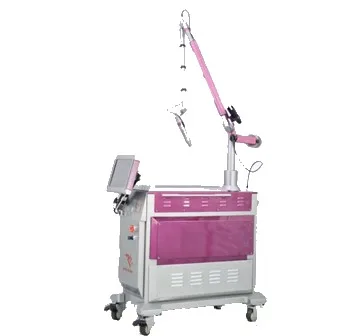
QN-03
1064/532nm Q-switched Nd:YAG for tattoos, pigment and carbon peel mode.
View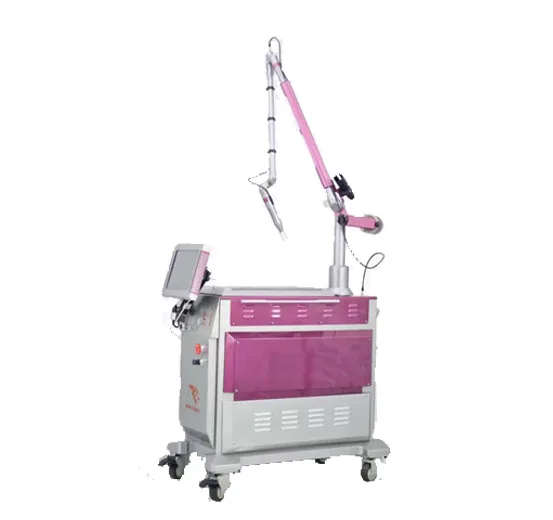
QE-01
Dual 1064/532nm nanosecond pulses for tattoo removal, nevus of Ota and pigment.
View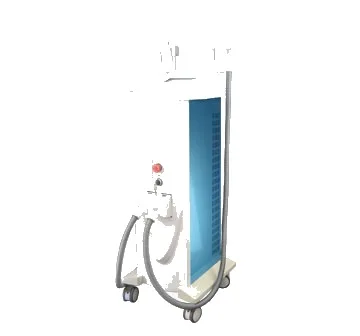
PE-01
High-performance E-light (HPT) platform with triple cooling and fast filter changes.
ViewFrequently asked questions
How many sessions should I sell?
Around ten; the literature runs five to fifteen, weekly or every other week. Sell it as a programme with a photographic review point, never as a promise of clearance, and quote the maintenance rate from day one.
Can I just use higher energy and finish faster?
No, and this is the rule your staff will test. Melasma answers aggression by darkening. Push fluence and you get rebound hyperpigmentation; the endpoints you'd be chasing — blanching, pinpoint bleeding — are what our operating guidance warns lead to serious pigmentation. Room rule, in writing: energy never rises because a client asked for speed.
What changes for Fitzpatrick IV to VI skin?
More epidermal melanin means more competing absorption, so an identical panel setting lands harder on darker skin. Low end of the fluence range, spot as wide as the handpiece allows, longer interval, and the test patch treated as binding rather than advisory. The systematic review notes that aggressive use induces hyperpigmentation through unwanted inflammation, especially in darker skin. Operator experience beats any specification sheet here.
A client has developed pale mottled patches. What now?
Stop the course. Mottled hypopigmentation appeared in 21 of 177 patients within ten sessions in the pooled data — about one in eight — it's linked to accumulated energy, and it can persist. Photograph it, log the cumulative figures, refer to a dermatologist. Don't try to laser it back. Then audit your file: totals running high across several of that operator's clients is technique drift, and drift is fixable.
Should I offer melasma at all if I only own one machine?
You can, with two conditions. Run the fluence sum above on whatever console you own and check it reaches the dose you mean to work at. Then be honest about discipline: slow protocol, cumulative energy logged, a firm no to the wedding-in-six-weeks client. Miss either and melasma generates more complaints than revenue.
References
- Lee YS, Lee YJ, Lee JM, Han TY, Lee JH, Choi JE. The Low-Fluence Q-Switched Nd:YAG Laser Treatment for Melasma: A Systematic Review. Medicina (Kaunas). 2022;58(7):936. (Fluence usually 1-3 J/cm2, spot 6-10 mm, 5-10 Hz, around 10 sessions weekly or biweekly; mottled hypopigmentation in 21 of 177 patients within 10 sessions; relapse in 20 of 34 at one year.)
- American Academy of Dermatology. Melasma: Self-care. (Tinted sunscreen containing iron oxide, SPF 30 or higher, for visible-light protection.)
- U.S. Food and Drug Administration. FDA Warns Consumers of Skin Products Containing Mercury and/or Hydroquinone. (No FDA-approved or legally marketed OTC skin lightening products; mercury and hydroquinone found in tested products; ochronosis among listed risks.)
Build a treatment bundle.
Get a quote for the machines behind this solution, configured to your clinic and market.