Tattoo removal
Tattoo removal is the least glamorous line on a price list and often the steadiest earner. This page is about running the room and the diary, not reading a spec sheet.
Why tattoo work sits on your books for a year
A tattoo client sits on your books for a year, sometimes two, and each appointment is short. The business case in one sentence: little chair time, high repeat rate, almost no consumables. The catch sits in the first consult: a client expecting clean skin by visit three will argue with you through the remaining nine.
Nanosecond Q-switched Nd:YAG at 1064nm and 532nm is what the literature keeps landing on for photoacoustic clearing of ink. A double-centre Italian retrospective published in Life in 2021 treated 52 patients with 6ns pulses at those two wavelengths and reported a mean of 4.6 sessions to a satisfactory result, with 51.9% of patients giving the highest satisfaction scores. The average hides a wide spread.
So why not just buy picosecond?
Bäumler and colleagues ran a prospective split-tattoo trial — half the tattoo picosecond, half nanosecond — and published it in the Journal of the European Academy of Dermatology and Venereology in 2022. Both systems reached acceptable clearance. Picosecond came out ahead on average, though not by a statistically significant margin, and it hurt less and left less collateral damage. It also costs a great deal more to buy and to depreciate, which is a real line on a small clinic's books. Everything below is written for nanosecond hardware. The limit: stubborn green and yellow work, and clients who insist on the fewest possible visits, sit outside where a nanosecond console is comfortable — set expectations very hard on those, or refer out.
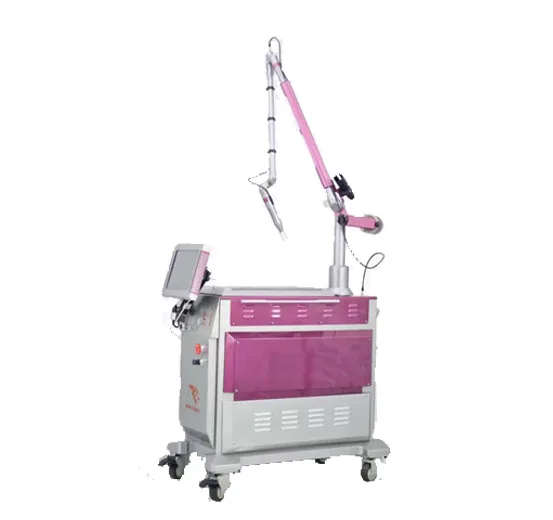
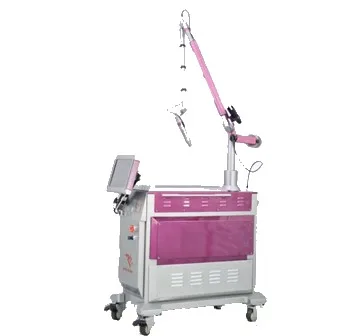
The real decision isn't wavelength. It's which Q-switch goes in which room, who holds the handpiece, and how you price a course you can't predict. Our two consoles split along exactly that line: the QE-01 electro-optic Q-switched Nd:YAG for stubborn, layered and multi-colour work, and the QN-03 passive Q-switched Nd:YAG for bread-and-butter black ink plus a carbon peel mode that fills gaps in the schedule.
One caution. This is operational guidance written for clinic owners and their staff, not medical advice, and local licensing decides who may legally operate a Class 4 laser on skin. Anything that looks like a suspicious lesion inside a tattoo goes to a dermatologist, not under your handpiece.
What the energy dial actually changes on a Q-switched machine
The Q-switch type changes how your technician turns the dial
The energy dial does not mean the same thing on our two consoles, so train and sign off staff on each machine separately: a technician who assumes the knob behaves the same way on both will over-treat on one of them. On a dense, deep professional piece you want a bigger single shot rather than more shots. The physics behind that — how the EO energy control behaves shot by shot — is set out on the product page.
Wavelength follows ink colour, spot size follows depth
Our device manuals map it bluntly. 1064nm reaches deeper and handles black, blue, grey and brown wherever the pigment sits, epidermal or dermal. 532nm is for red and for superficial pigment, and it comes out as visible green light, which matters for eyewear. Green ink stays the problem child; the FDA's own consumer guidance says so in plain language: yellow, green and red are harder to remove than dark blue and black, and scarring and infection sit on its list of real risks.
Spot size is the control operators under-use: our manuals keep dermal ink above 2mm and reserve sub-2mm spots for junctional naevi and scar work, and the depth reasoning behind that rule is explained on the QN-03 page. One more archive note: when the target pigment is epidermal, skip the contact cooling. Pre-cooling drops the epidermal baseline temperature, so an epidermal target never climbs to the peak temperature you were aiming for.
Tattoo removal protocol: from consult to the whitening endpoint
The consult that saves you nine arguments
Score the tattoo before you quote it. The Kirby-Desai scale, published by Kirby and colleagues in the Journal of Clinical and Aesthetic Dermatology in 2009, assigns points across six things: skin type, body location, colour, amount of ink, scarring and layering. Each point corresponds roughly to one expected session. In the retrospective chart review of 100 patients behind that proposal, the authors reported a correlation coefficient of 0.757 between score and outcome — useful and imperfect, so quote it as a range rather than a promise. The FDA's consumer material says removing a tattoo may take 6 to 10 treatments.
Screen properly while you have them in the chair. Our device manuals list the hard stops: cardiac pacemakers or implanted defibrillators, severe diabetes, hypertension, heart disease or epilepsy, vascular surgery on the treatment area within the past two months, broken skin, active herpes or any malignant lesion in the field, existing scars, pregnancy, and functional cosmetic treatments in the past month. Add keloid tendency to that list. Photograph the tattoo under fixed lighting, write the parameters into a treatment record, and get a signature.
Two session counts on this page disagree, and you should know why. The 4.6-session mean comes from a two-centre retrospective on a selected caseload, where "satisfactory" is not the same as gone without a trace; the FDA's 6 to 10 is a broad consumer-facing range covering everyone who walks through a door. Small amateur black work lands at the low end, professional multi-colour pieces, cover-ups and heavily layered work at the top and sometimes past it. Quote the case in front of you against the end it resembles, and say which end you picked.
First session, shot by shot
- Clean the area with a gentle cleanser and dry it completely. A water film reflects and scatters part of the beam, so the dose reaching the ink drops with no warning on the display.
- Goggles on both of you. 532nm output is visible green and operators need eyewear rated across roughly 200 to 1080nm. Never point the tip anywhere but the target. And one hard line for anything periorbital: eyeliner or eyebrow permanent makeup is not a goggles job. Those cases need metal intraocular corneal shields placed under the lids with topical anaesthetic, by an operator qualified to do it and working under medical supervision — goggles sit outside the lid and protect nothing from a beam aimed at the lid itself. A 2018 review of ocular injuries in facial laser work by Huang and colleagues in the Journal of Clinical and Aesthetic Dermatology found protection absent or removed in more than 62% of the collected cases, and injuries still occurred in a third of cases where shields and goggles were used correctly. No shields and nobody trained to place them means you don't take eyeliner cases at all — refer them out.
- Hold the treatment tip at 90 degrees to the skin. An articulated arm delivers evenly only when it is vertical.
- Start low. Fire three to five test shots, wait, read the response. Step up from there to the client's working level, not to a number someone gave you on a course.
- Overlap each spot by about a third and keep the pass even. Your endpoint is immediate whitening of the pigment: when the ink lightens, the dose is adequate. Stop chasing pinpoint bleeding or swelling; that is over-treatment, not thoroughness.
For reference on dose, the Italian study cited above ran 1064nm on black and blue ink at fluence up to 10 J/cm² and 532nm on coloured ink up to 5 J/cm², both at 6ns. Treat that as a published ceiling, not your starting point.
Spacing and the complications you will actually see
Space sessions further apart than clients want. That same study used a minimum interval of eight weeks between treatments and increased it to twelve weeks after the fourth session, on the reasoning that lymphatic clearance and the skin both need the time.
Aftercare, straight from our manuals: no washing or touching the area for two to three days, let any scab drop off by itself, strict sun protection, and easy on alcohol and spicy food while it heals. Tiny pimple-like bumps right after a session are normal and settle within a couple of hours. Erythema fades over days. Our manuals' adverse-reaction section describes hypopigmentation as easing on its own over time, and usually it does — but a minority never fully returns, so put that line in the consent form and not just in the conversation. The same section rates post-inflammatory hyperpigmentation as uncommon, tied to skin colour, and generally clearing over months. It rates scarring as rare as well, while warning against treating anyone with a keloid tendency and noting that poor aftercare causes some of the scars people go on to blame on the laser. The FDA lists scarring and infection among the genuine risks of laser removal. Log every call-back.
Keep an escalation route written down: who you ring for a suspected corneal abrasion, who you ring for a wound that stalls.
Running the room: throughput, pricing and which console
What it does to your hour and your margins
A palm-sized black tattoo is a short appointment. Prep, eyewear, test shots, the pass itself, aftercare talk. Book it like a short slot and you can run several in an afternoon without tiring your operator's aim. The economics are genuinely clean: no disposable cartridges, no cryogen to run dry, no gel. Your running cost is lamp and rod life plus electricity, and the single biggest thing protecting your energy output is somebody cleaning the treatment tip properly with lens paper or pure alcohol between clients.
Two maintenance items get forgotten. Our manuals ask for a full water change every two months, cycling the machine a few times after refilling so the loop clears. And never clean the housing with petrol, alcohol or thinners. Room setup is part of the protocol too: nothing reflective on the walls or trolleys, metal jewellery off the client, a sign on the door, and nobody walking in mid-session.
Pricing a course you can't predict
Charge per session. Quote the range that came out of the score, then bill visit by visit, so a tattoo that scores low and behaves badly doesn't quietly eat a year of your chair time.
A package earns its place only on retention. Take a deposit that sits as credit against future visits — it holds a client who has to keep coming back for a year — and price any sessions beyond your quoted range at a reduced rate. The client feels looked after when the ink outlasts the estimate, and you still get paid for the room.
Before this goes anywhere near a contract: the Kirby-Desai score tracked actual sessions at a correlation of 0.757, not at 1. Sell a fixed total for complete removal and every underestimated case comes out of your margin. Guarantee your process, never the finish line.
Which console goes in which room for tattoo work
| Case type | Console | Why |
|---|---|---|
| Amateur black or blue single-colour work | QN-03 | Your volume case. Forgiving to run, and a newer operator can be signed off on it sooner. |
| Cover-up over old ink, layered pigment | QE-01 | Needs more punch per shot, not more shots. |
| Multi-colour professional piece | QE-01 | Colour work means changing the setting constantly; you want per-shot control you can actually feel. |
| Client already stalled on someone else's laser | QE-01 | Whatever they had wasn't reaching the ink. Change the lever, not the number of passes. |
| Gaps in the diary, walk-in glow-up | QN-03 | Carbon peel mode turns dead time into a paid express treatment. |
If you are running one machine, the passive unit covers the volume. Most walk-in tattoo work is black or blue ink, which the QN-03 handles, plus the carbon peel above. Its adjustable spot also earns its keep on freckles and epidermal pigment and, at low fluence toning settings, on melasma programmes where restraint matters more than power.
Add the electro-optic console once the QE-01 rows in that table start showing up in your diary every week. That is where finer control over single-pulse energy becomes the difference between clearing a piece and ghosting it. Sign a technician off on demonstrated ability, not on weeks served — in practice a handful of supervised real cases, not one demo; the sign-off criteria are in the FAQ below. Read our service and training notes or talk to us about operator handover before the machine ships.
Frequently asked questions
How many sessions should I quote, and how should I charge for them?
Score the tattoo with the Kirby-Desai scale at the consult, then quote a range with an honest ceiling. The FDA's consumer guidance says removal may take 6 to 10 treatments, while the published nanosecond Q-switched series reported a mean of 4.6 sessions to a satisfactory result in a selected caseload. Never quote a single figure, and tell the client which end their tattoo sits at. Charge per session rather than selling a fixed-price package for complete removal, and put in writing that complete clearance without any mark is not guaranteed.
How long should I leave between sessions?
Eight weeks minimum, and stretch it after the fourth. The double-centre study behind most of this page moved to twelve-week intervals from that point onward, because the body needs time to clear fragmented pigment and the skin needs it to recover. Clients push for faster. Hold the line: crowding sessions buys you ghosting and pigment change, not speed.
Which ink colours give you trouble, and what if the ink turns black?
Green is the classic hold-out. The FDA's consumer guidance ranks yellow, green and red as harder to remove than dark blue and black. Red and superficial pigment answer to 532nm; deep black and blue belong to 1064nm.
The other problem, and the one that costs you a client: paradoxical darkening. Light inks — white, peach, pink, yellow, and plenty of permanent makeup — can flip dark under a Q-switched pulse, generally through iron oxide or titanium dioxide reacting to the light. Kirby and colleagues walked through the mechanisms in the Journal of Clinical and Aesthetic Dermatology in 2013. Darkened ink is not automatically a dead end. In the original five-case report by Anderson and colleagues in Archives of Dermatology, 1993, three cleared with further laser sessions and two ended up needing surgical excision. Treat it as unpredictable, and as a case you may not finish inside the visits you quoted. Test-shoot a hidden corner of any permanent makeup first, warn them in writing, and for eyeliner or eyebrow work don't take the case at all unless you have metal corneal shields and someone qualified to place them under the lids.
Can I put a junior technician on tattoo removal?
Not on day one. The failure modes are quiet ones. Firing on damp skin and silently losing dose. Reading swelling as a good endpoint instead of whitening. Assuming the energy dial does the same thing on a passive and an electro-optic machine. Every one is a training problem, not a machine problem. Supervise real cases until they can call the whitening endpoint reliably, justify the spot size they picked, and screen contraindications without a prompt sheet. Sign them off on that, not on a date in the calendar.
A client blistered after their session. Now what?
Cool the area, keep it clean, and do not let them pick at it. Our manuals are firm that the scab must fall off by itself and that sun exposure during healing is what turns a normal reaction into a lasting mark. Tell clients to ring you rather than self-treat. Anything with spreading redness, pus, worsening pain or a wound that stalls needs a doctor the same day, not a rescheduled laser appointment. Log it, photograph it, and adjust the parameters in that client's record before the next session.
References
- Cannarozzo G, Nisticò SP, Zappia E, et al. Q-Switched 1064/532 nm Laser with Nanosecond Pulse in Tattoo Treatment: A Double-Center Retrospective Study. Life (Basel). 2021;11(7):699.
- Kirby W, Desai A, Desai T, Kartono F, Patel G. The Kirby-Desai Scale: A Proposed Scale to Assess Tattoo-removal Treatments. J Clin Aesthet Dermatol. 2009. (Retrospective chart review of 100 patients; correlation coefficient 0.757.)
- U.S. Food and Drug Administration. Tattoo Removal: Options and Results (Consumer Update). 6 to 10 treatments; yellow, green and red harder than dark blue and black; scarring and infection listed as risks.
- Bäumler W, Breu C, Philipp B, Haslböck B, Berneburg M, Weiß KT. The efficacy and the adverse reactions of laser-assisted tattoo removal — a prospective split study using nanosecond and picosecond lasers. J Eur Acad Dermatol Venereol. 2022;36(2):305-312.
- Kirby W, Chen CL, Desai A, Desai T. Causes and Recommendations for Unanticipated Ink Retention Following Tattoo Removal Treatment. J Clin Aesthet Dermatol. 2013.
- Anderson RR, Geronemus R, Kilmer SL, Farinelli W, Fitzpatrick RE. Cosmetic tattoo ink darkening: a complication of Q-switched and pulsed-laser treatment. Arch Dermatol. 1993;129(8):1010-4.
- Huang A, Phillips A, Adar T, Hui A. Ocular Injury in Cosmetic Laser Treatments of the Face. J Clin Aesthet Dermatol. 2018;11(2):15-18.
Build a treatment bundle.
Get a quote for the machines behind this solution, configured to your clinic and market.