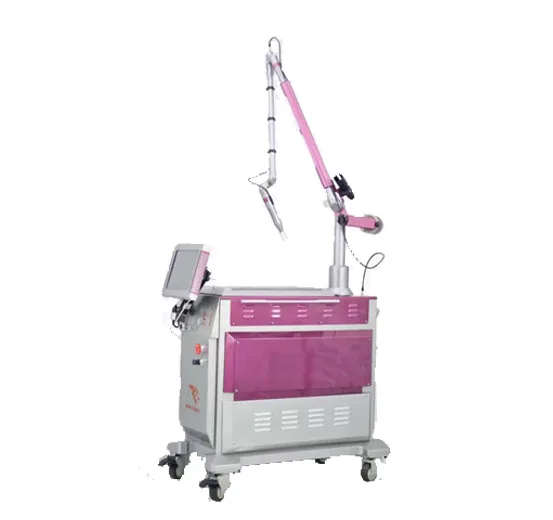
Pmise QE-01
An electro-optic Q-switch changes what happens when your technician turns the energy dial. This page is about running the QE-01 in a treatment room, not about its spec sheet.
What the EO switch changes in your treatment room
Two machines can both be sold to you as a Q-switched Nd:YAG laser and behave nothing alike in a technician's hands.
Our internal light-and-tissue training material sets them side by side: on an actively switched cavity, turning the energy up raises the peak power of a single pulse while the pulse width stays put; on a passively switched cavity it mostly adds pulses. So the QE-01 gives your operator one continuously variable shot, where a passively switched platform like the QN-03 gives stacked shots plus a carbon peel mode.
The EO version earns its place on deep pigment: nevus of Ota, the blue-grey to brown macules over the malar area and around the eye, and nevus of Ito, which our internal dermatological atlas places on the shoulder and upper arm in the acromio-deltoid distribution rather than the face. Dense professional ink sits in the same bracket. Below roughly 200mJ of single-pulse energy our device archive advises against treating nevus of Ota at all: no meaningful result, longer courses, more pain, higher complication risk.
Technical detail
| Wavelength | 1064 / 532 nm |
|---|---|
| Q-switch | Electro-optic (EO) |
| Pulse width | 6 ns |
| Spot size | 1 to 8 mm, continuously adjustable |
| Repetition rate | 3 to 10 Hz |
| Energy | 800 mJ single pulse at 1064 nm |
| Applications | Tattoo, nevus of Ota, pigment |
| Warranty | 12 months, lifetime maintenance |
What your technician is actually controlling
What photoacoustic means at the console
Our technical documentation works it through with a 200mJ Nd:YAG. Unswitched, that energy leaves the cavity over roughly 400 microseconds; switched to about 10 nanoseconds the pulse is some forty thousand times shorter, so peak power climbs by the same factor and pigment granules shatter mechanically, with almost no thermal coagulation or ablation.
Nanoseconds and not milliseconds, because melanosomes sit in the sub-microsecond range - our training material puts them at roughly 0.5 to 1 microsecond, and published teaching figures run to a few hundred nanoseconds for smaller granules. Tattoo dye particles are lower still. At a given wavelength, higher energy density breaks the granules more completely.
The dials that decide the session
Energy, spot diameter, wavelength. At the same energy density a wider spot reaches deeper, because proportionally less light scatters away at the edges, so our archive keeps dermal pigment work above 2mm and reserves spots below 2mm for junctional naevi and scars.
Wavelength follows target colour and depth: 1064nm removes black, blue and green-blue ink and reaches dermal pigment; 532nm takes red and shallow epidermal work. Green suits ruby and alexandrite wavelengths better, and yellow and pastel shades are hard to shift completely. Dry the treated area first, because moisture bleeds energy away before it reaches the target, and keep the tip perpendicular, overlapping each spot by about a third.
Where to set the dials on the first pass
Starting points from our protocol sheets, not prescriptions; each assumes the same opening move, three to five shots at the lowest usable setting, then read the skin. Repetition rate runs 3 to 10Hz, with new staff at the bottom of that band.
- Tattoo ink - 1064nm for black, blue and green-blue, 532nm for red; spot and opening energy off the calibration chart supplied with your unit.
- Epidermal pigment, cafe-au-lait type - 532nm on lighter phototypes, 1064nm from type III upward; spot at least 3mm, from around 200mJ.
- Dermal pigment, nevus of Ota or Ito - 1064nm, spot at least 3mm, from around 400mJ; go too low and nothing fragments.
- Zygomatic macules - 1064nm, spot above 4mm, from around 200mJ.
- Facial work on or adjacent to melasma - 1064nm, spot no smaller than 6mm, from around 200mJ, and the most conservative endpoint on the machine.
Every spot figure above sits inside the 1 to 7mm adjustable range this head delivers; if an inherited protocol sheet falls outside that range, check it against the manual shipped with your unit.
Screening, spacing and endpoints, session by session
Screening, and the rule that saves you a refund
Recent sun exposure, photosensitising medication, pregnancy, active infection, keloid or cicatricial diathesis, and any prior treatment on the same site. Anything pigmented that is changing shape, colour or border goes to a physician first, because a shattered lesion cannot be assessed by a pathologist.
Any cosmetic tattoo - eyebrow, eyeliner, lip line - and any design with flesh-toned or cover-up ink gets a test spot and a wait, never a full pass on the day. Our internal training manual is explicit: red, brown, white and skin-coloured pigments containing iron or titanium dioxide can change chemically under laser light and turn a persistent grey-white or black, fading only gradually over later sessions. Put it in the consent form and photograph before you fire.
Eyewear: this platform outputs 1064nm and 532nm, and our manuals specify glasses rated across roughly 200 to 1080nm so one lens covers both. Single-wavelength goggles from a diode hair removal system do not qualify, and everyone in the room wears them.
The test spot, and endpoints indication by indication
The immediate read: fire three to five shots at the low setting and watch that point for about ten minutes against the endpoint for that indication below. The delayed read is a separate appointment - for cosmetic tattoos, cover-up ink and Fitzpatrick IV and above, do not set full-field parameters the same day, because paradoxical darkening and post-inflammatory pigment show up later. On zygomatic macules our archive notes pigment often looks worse at two to four weeks before it clears.
- Tattoo ink - immediate whitening of the treated point, visible within a second. Pinpoint bleeding means you have gone past it.
- Epidermal pigment, freckles, lentigines, cafe-au-lait - light red, pigment visibly more scattered, and no dense frosting.
- Dermal pigment, nevus of Ota or Ito, zygomatic macules - mild erythema, at most a slight ooze on dense lesions. A whitened patch on facial dermal pigment is an overshoot signal: stop the session there.
Melasma is the exception in that third group: light red, no ooze, no whitening, stop - our manuals are direct that bleeding or a whitened patch on a melasma face leads to serious pigmentation afterwards. Standing low-fluence toning is work our melasma notes hand to the passive QN-03 and PE-01.
Spacing a course, and aftercare your front desk can recite
The laser fragments the pigment; macrophages clear it, and that takes weeks. Our protocol sheets space courses by target: hyperpigmentation roughly weekly across ten to fifteen sessions, zygomatic macules around 45 days apart, nevus of Ota and Ito 60 to 90 days over six to eight sessions, cafe-au-lait at 45 to 60 days.
Kar and Gupta treated 50 Indian patients of phototypes IV and V monthly with 1064nm Q-switched Nd:YAG, five sessions on average (Indian Journal of Dermatology, Venereology and Leprology, 2011): near-total improvement in 8 percent, marked in 22 percent, moderate in 38 percent, 32 percent under 25 percent clearing; transient post-inflammatory hyperpigmentation in 4 patients, 8 percent, cleared within 2 months with sunscreens and bleaching agents, no textural change or scarring. One cohort on one protocol, not a promise for yours.
Aftercare: no touching or washing for two to three days, no scratching, and let the scab separate on its own, since a light scab is normal on dermal pigment work. Keep a gel or light enhancer on zygomatic and nevus work so the area stays moist and heavy crusting is avoided. Strict sun protection throughout, and ease off alcohol, smoking and sharply spicy food while healing. Expect small papules for an hour or two and erythema fading over several days.
What it costs to run and where the revenue comes from
Costing a session straight off the shot counter
The control panel carries wavelength, energy, repetition rate, water temperature and flow, working status, and two counters: a lifetime total and a per-session count that resets to zero at every power-off. Read the session counter before you shut down, because consumable cost per treatment is the quoted lamp and rod replacement price divided by the rated shot count for your unit, times the shots fired. Ask us for both figures in writing before you price anything; chair time, not the consumable, usually sets the price.
Maintenance, and where the revenue comes from
No disposable cartridges, no cryogen canister. The cooling loop takes purified water: our manuals specify roughly 1.8 litres on filling, with a full change every couple of months, then running the machine a couple of minutes and repeating the cycle at least twice so the circuit clears. Keep the CPC fitting seated in the overflow hole or the machine will not run. Clean the treating tip, and never use alcohol on the head or the treatment area. Neglect the optics and you will slowly push energy higher to chase the same endpoint, which is how burns start. Check your service terms for what is covered.
Tattoo removal is prepaid and multi-session and feeds resurfacing and scar work, so a fractional CO2 platform and a water-oxygen jet pair naturally with it; dermal pigment work is the quieter earner.
Frequently asked questions
How does single-shot energy control change my tattoo quoting?
The EO switch raises peak power on one continuously adjustable pulse instead of stacking more, so your operator can reach the energy density a dense or deep piece needs on a single shot. How the Kirby-Desai scoring approach weighs skin type, location, colour, ink volume, scarring and layering, and why FDA consumer guidance says complete removal may not be possible, are covered on our tattoo removal solution page. Quote a course, never a single session, in writing.
Can I treat Fitzpatrick V skin with this?
Carefully, and at 1064nm - the Kar and Gupta series above ran in phototypes IV and V. Start at the bottom of the energy band, keep the delayed test-spot read, widen your interval at the first sign of pigment change, and insist on sun protection between visits.
What goes wrong most often, and what do I do about it?
- Post-inflammatory hyperpigmentation. Related to skin colour, usually resolving over months. Pause the course, sun avoidance, gentle topical care, lower energy on restart.
- Paradoxical darkening of cosmetic or flesh-toned ink. Do not chase it with more energy; stop, photograph it, consider switching wavelength or referring on, and resume only after a delayed review.
- Transient hypopigmentation. Generally eases with time.
- Blistering or infection, almost always where a crust was picked. Stop treating that site and refer to your supervising physician; any antibiotic cover is a physician's decision, never a technician's.
Scarring is uncommon and usually traces back to excessive energy, infection, or a client who was never a candidate.
What should my technician check before the first client each morning?
Water level and flow with the CPC fitting seated, foot pedal and interlock connected, no reflective or flammable material in the room, both pairs of 200 to 1080nm goggles unscratched, treating tip clean, and the machine parked in standby rather than ready. Ask our team for the consent forms, screening sheet and record template we ship with the unit. This page is general operator guidance, not clinical or medical advice; it does not replace the manual shipped with your unit, and your supervising physician and local regulations outrank anything here.
References
- Kar HK, Gupta L. 1064 nm Q switched Nd:YAG laser treatment of nevus of Ota: an Indian open label prospective study of 50 patients. Indian J Dermatol Venereol Leprol. 2011 Sep-Oct;77(5):565-70. (Phototypes IV-V; mean 5 sessions; near-total 8%, marked 22%, moderate 38%, <25% clearing 32%; transient PIH in 4 (8%) cleared within 2 months; no textural change or scarring.)
- Kirby W, Desai A, Desai T, Kartono F, Patel G. The Kirby-Desai Scale: A Proposed Scale to Assess Tattoo-removal Treatments. J Clin Aesthet Dermatol. 2009;2(3):32-37.
- U.S. Food and Drug Administration, consumer update: Tattoo Removal: Options and Results (multiple treatments needed, weeks between sessions, complete removal may not be possible).
- American Society for Laser Medicine and Surgery (ASLMS) mentorship primer: Vascular Lesions, Pigmented Lesions and Resurfacing - melanosome thermal relaxation time in the sub-microsecond range and the rationale for Q-switched pulse durations.
Quote the Pmise QE-01.
Tell us your country and clinic type. We reply within 24 hours with technical detail, pricing and the spare-parts picture.