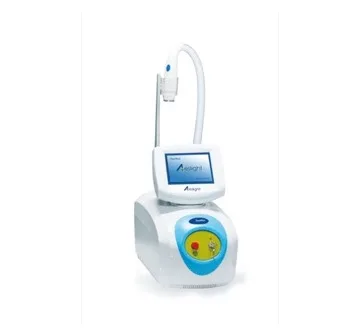
Pmise RF-01
RF is the device your team will run most often and understand least. Nothing flashes, nothing snaps, and the endpoint is a temperature nobody can see. This page is about the hand on the handpiece.
What this platform does
You've already decided you want a tightening device in the room. So let's skip the sales pitch and talk about the thing that decides whether it earns: technique.
RF-01 is bipolar. Current passes between two electrodes on the same handpiece, the tissue in between heats up, and collagen responds. That's the whole mechanism. No flash, no snap, no scab. A client who has had a fractional laser will tell you RF feels like a warm stone massage — which is lovely for rebooking and terrible for quality control, because an undertrained therapist can drift the handpiece around for forty minutes, never reach temperature, and send someone home with nothing.
One fact your staff need before they touch it. RF doesn't chase a colour, so it isn't pigment-limited the way an IPL is — the ownership case for that sits further down this page. What it does not mean is that skin type stops mattering. Fitzpatrick IV to VI gets the same temperature discipline as everyone else, applied more carefully rather than less. Which brings us to the only sentence here that really matters: "does the skin look tighter yet" is the wrong endpoint during a session. Temperature is the endpoint. Everything below is built around that.
Nothing here is medical advice. It's an operator's guide for trained clinic staff, and your local scope-of-practice rules always win.
Technical detail
| Technology | Bipolar radio frequency |
|---|---|
| Frequency | RF dermal heating |
| Electrodes | Interchangeable face/body |
| Skin types | All Fitzpatrick types |
| Applications | Tightening, lifting, wrinkles |
| Warranty | 12 months, lifetime maintenance |
How it works
One session, in the order it happens
- Photograph before you gel. Same distance, same light, face relaxed and not smiling, no jewellery. Laxity photographs badly at the best of times. Do this sloppily and the three-month review becomes an argument you cannot win.
- Degrease properly. Makeup, sunscreen and oil all sit between the electrode and the skin. Uneven contact is uneven heating, and uneven heating is where the hot-spot complaints come from.
- Gel generously, then top up. Thin gel drags. Drag makes your therapist slow down and press harder, which is precisely the wrong instinct. If the handpiece squeaks, you're already behind.
- Choose the electrode by depth, not by area. More on this below. It's the decision most operators get wrong.
- Work one small zone at a time. Our archived body protocol marks the skin into a grid of roughly six by five centimetres and treats block by block. Copy that. Keep the handpiece moving in overlapping strokes and count passes, not minutes — the same sheets call for around three passes per block, twenty to thirty seconds each. Stationary contact on a bipolar tip is how you make a blister.
- Climb the energy, don't start at the top. Open low, run a few passes, ask the client to describe the warmth. "Comfortably hot, like a bath you'd stay in" is the target. "Sharp" or "stinging" means stop and drop a step — that sensation is a burn announcing itself early.
- Measure the surface, don't guess it. A cheap infrared thermometer is the best money you'll spend on this machine. How you point it matters as much as owning it, so read the reading protocol below and make every therapist in the building use the same one.
- House rule, printable, one card, and it isn't negotiable: surface ceiling 40–43°C; dwell at target one to two minutes on thin facial and neck skin, three to five minutes on thicker face zones and body; lift off the moment the thermometer reads above 43°C. Print it. Tape it to the trolley. Nobody improvises around those numbers.
- Finish the zone before you move. Never leave a block half-heated to "come back to it" — you'll lose track of dwell and double-treat it.
- Cool, moisturise, sunscreen. Redness and a little puffiness are normal. Cleveland Clinic's patient guidance says those settle within about 24 hours, which is a useful line to give clients up front.
The numbers, in one block
- Course length — three to six sessions for bipolar RF, against one or two for monopolar platforms (Health Science Reports, 2025). Our own body sheets run four to six on larger areas.
- Interval between sessions — about fifteen days on body zones in our archived protocol. Weeks, never consecutive days.
- Surface temperature ceiling — 40–43°C read off an infrared thermometer at the skin. Above 43°C, leave the zone (our archived protocol; Health Science Reports, 2025).
- Dwell at target — one to two minutes on thin facial and neck skin; three to five minutes on thicker face zones and body (our archived protocol; Health Science Reports, 2025).
- First measurable change — contraction in the first weeks is subtle, and measurable facial lifting has been documented around four weeks post-treatment (Health Science Reports, 2025).
- Full result — roughly two to six months (Cleveland Clinic), with collagen density still improving at six months in published follow-up (Health Science Reports, 2025).
Electrode choice is a depth decision
Here's the rule that makes bipolar RF make sense. In the 2020 Plastic and Reconstructive Surgery – Global Open review by Dayan, Burns, Rohrich and Theodorou, bipolar penetration depth runs to roughly half the distance between the two electrodes. Half the gap. That's it.
So a narrow-gap face electrode is a shallow tool, and the wider body electrode reaches deeper. Sending a therapist at an abdomen with the fine periorbital tip doesn't just work slowly — it heats the wrong layer entirely, and you'll burn an hour of chair time for a result nobody can photograph. Train the swap as a reflex, not a preference.
What temperature, and for how long
The 2025 review in Health Science Reports by Zhang, Tan, Zhang and Wu recommends a lower temperature held longer — their words are 43°C for three to five minutes — to get collagen remodelling while avoiding burn risk. Our own RF face protocol sheet sits fractionally under that: 40–41°C maintained one to two minutes on thin facial skin, three to five minutes where the face is thicker, with a written end-point of keeping epidermal temperature below 45°C. Read together, that's one temperature ceiling for both face and body, two dwell times. Thin facial and neck skin, one to two minutes at target. Thicker face zones and body, three to five. Which is why the house number above is 40–43°C and nothing else.
How to take a reading you can repeat. Aim at the centre of the block you have just finished, and read it the instant you lift off — not after you've gelled the next zone and wandered back. Pick one method for the whole clinic and write it on the same card: either wipe a small window of gel clear and read bare skin, or read straight through the gel every single time. Don't mix them, because they won't hand you the same number. Check the distance-to-spot ratio marked on whatever thermometer you bought and hold it close enough that the sensor is seeing only that block. Keep one thermometer per room, too — the moment two guns are in circulation, staff start arguing about which is right instead of lifting off. Readings disagree? The house method wins, every time.
You will read papers quoting much higher subdermal temperatures. Those come from invasive RF-assisted probes placed under the skin. A surface thermometer cannot see them, they are not your endpoint, and treating them as a target is how a technician talks themselves into another five minutes on an already-hot cheek. Ignore them.
The neck deserves its own warning. Our protocol notes flag that neck skin is much thinner than face, so it climbs faster — check temperature more often there, not less, and stay off the thyroid entirely. Eyelids are never treated.
How many sessions, how far apart
Don't sell a single session. That 2025 review puts bipolar systems at three to six sessions, versus one or two for monopolar — a genuine difference in how you package this, and one your front desk needs to understand before quoting. Space them by weeks; our archived body protocol books at roughly fifteen-day intervals across a four-to-six session course.
Tell clients the timeline honestly. Early collagen contraction is subtle. What holds the result is neocollagenesis, and Cleveland Clinic's guidance points to visible change over a two-to-six-month window — published follow-up shows collagen density still improving at six months. Clients who expect a mirror moment on the drive home are the ones who ask for refunds.
If something goes wrong
- Know the 24-hour line. Normal is erythema plus mild swelling that settles within about a day, occasionally with faint red spots lingering across the following week. Abnormal is burning pain that outlasts the appointment, a sharply demarcated white or grey patch, or any blister. That's a burn, not a reaction.
- Blister or suspected burn — the first three actions. Stop treating that zone immediately. Cool it with a clean damp compress, not ice straight onto skin. Do not deroof it, drain it or pick it. Then cover with a sterile non-adherent dressing, photograph it, and write it into the client's file before they leave the building.
- Know who takes over. Any blister, any broken skin, anything still painful the next morning goes to your supervising clinician or a dermatologist that day. Signs of infection — spreading redness, pus, fever — are urgent. Thermal injuries are not managed by text message.
- Watch pigment on darker skin. Daily broad-spectrum sunscreen, no picking, and review at two weeks and again at six. If pigment does change, have it assessed rather than treated over.
- Delay the next session properly. No more RF on that area until the skin is fully healed and cleared by whoever is clinically responsible. Weeks, not days. When you restart, drop an energy step, shorten dwell, and re-verify with the thermometer from the first pass.
- Aftercare prevents most of this. Our protocol sheets are specific: moisturise heavily, avoid alcohol- and AHA-heavy products for three to four days, and skip sweaty workouts, saunas and alcohol for three to four days — up to a week on sensitive skin. Sunscreen daily.
- Log it either way. Settings, electrode, passes, peak temperature, dwell, client comments. An incident with a complete record is a manageable problem. Without one, it's whatever the client remembers.
Applications and protocol
Who books well, and who you should turn down
Early laxity is where RF-01 shines. Softening jawline, crepey neck, the nasolabial area starting to shadow, post-partum abdominal skin that has lost its snap. Someone in their late thirties who has just noticed things moving is your ideal booking.
Advanced sagging is not. A client with heavy jowls and real tissue descent needs a surgeon, and the kindest thing you can do is say so in the consultation rather than after six paid sessions. Cleveland Clinic makes the same point — the technique is less effective on severely sagging skin. Losing that sale is cheaper than the review it turns into.
Screening questions before you switch on
- Any implanted electronic device? Pacemaker, defibrillator, neurostimulator, cochlear implant — that's a hard stop, not a doctor's-note situation. Our archived exclusion list names it first for a reason.
- Metal in the treatment field? Plates, screws, joint hardware, large dental implants, permanent jewellery. Route around it or don't treat.
- Pregnant or breastfeeding? Standard exclusion. Don't negotiate.
- Active infection, open lesion, or inflamed acne in the zone? Reschedule.
- Isotretinoin in the last year? Ongoing hormonal therapy? A history of skin malignancy? All flagged on the same archived exclusion sheet. These go to a doctor before they go on your table.
- Recent injectables, filler or threads in the area? Ask what, and when. Follow the injector's guidance, and if you can't reach them, wait.
- Reduced sensation anywhere in the field? Neuropathy, scar tissue, post-surgical numbness. The client's feedback is half your safety system — if they can't feel it, you've lost a sensor.
- Any undiagnosed lump, mole change, or lesion you don't recognise? Don't treat over it. Refer for assessment. That's a biopsy question, not a beauty question.
Where it sits against the rest of your room
RF-01 is a filler in the schedule and a finisher in the protocol. Both matter commercially.
As a finisher: after fat reduction, skin often needs to catch up. Pair it behind CR-01 cryolipolysis or SM-01 cavitation and you've turned a one-device result into a course — the logic laid out on the body contouring page. On the face, it partners with resurfacing rather than competing: texture and scarring belong to EF-01, laxity belongs here, and the skin resurfacing page walks through choosing between them.
As a filler: RF has no downtime and no light hazard, so it slots into the gaps a laser room can't fill. Lunch hours. The client who wants something before a wedding next week. The nervous first-timer who won't book a laser until she's trusted you with something gentler.
Key advantages
Your consumable line is zero
This is the quiet argument for RF and the one most buyers underweight. No tips to replace, no cartridges, no membranes, no gas. Gel and electricity. Our RF platform documentation flags the absence of disposables as the core ownership advantage, and after a year of running a diode or a Q-switch you'll appreciate why.
Do the arithmetic with your own numbers. Nobody can hand you a payback figure without knowing what you charge, so here's the frame — fill in your own values and it takes ten minutes:
- Marginal cost per session = gel + electricity + laundry and linen. On a consumable-based device you also add the tip, cartridge or gas burned in that session. On RF-01 that term is zero, which is the whole point.
- Contribution per session = your session price − marginal cost per session.
- Sessions to payback = delivered unit cost ÷ contribution per session.
- Then turn it into a calendar. Budget roughly an hour of chair time per session, three to six sessions per client course, spaced about a fortnight apart. Sessions to payback ÷ sessions per course gives you the number of clients; divide that by the courses your diary realistically starts each month and you have a date, not a feeling.
Run the same sheet against a machine that bills you for a tip every time someone lies down. That consumable term doesn't shrink as you get busier — it scales with you, straight out of contribution, session after session. Ask us to model it against your real booking mix through contact if you'd rather not build the spreadsheet yourself.
The training curve is short, but it has a cliff
The motion is intuitive and the machine is forgiving at low settings. You don't need a nurse to operate this. Sign staff off against your own written competency standard — supervised sessions, a protocol check, whatever your insurer and regulator expect — and note that the hard part here isn't the handling. It's the temperature discipline.
Two failure modes, opposite directions. The timid operator never reaches an effective temperature and produces nothing — your refund risk. The confident one parks the electrode, chases a stronger sensation and blisters someone — your insurance risk. Both come from the same gap: nobody taught them the endpoint is a number. Buy the thermometer. Write the pass counts, the two dwell times and the 43°C ceiling onto one card. Audit it.
RF isn't pigment-limited the way your IPL is
Here's the mechanism, once, properly. A laser picks melanin or haemoglobin and works on contrast. Radio frequency heats through tissue resistance instead, and the main energy receptor is water — the RF platform training material in our engineering archive is blunt about that. So epidermal melanin isn't competing for your energy, and RF-01 keeps working on skin your light-based devices treat cautiously or not at all. For a clinic serving Fitzpatrick IV to VI, that's a whole client segment your laser diary can't reach.
Just don't read it as licence to relax. Any thermal injury carries a materially higher post-inflammatory hyperpigmentation risk on darker skin, and the pigment that follows a burn is harder to fix than the burn was. Same ceiling, same card, more care.
All-year revenue
Light-based work slows in summer because of sun exposure rules. RF doesn't carry the same seasonal brake, and it tends to be the device that keeps rooms occupied when the laser diary thins out.
What actually ships, and who fixes it
So you can budget properly rather than searching for this later. RF-01 ships with interchangeable face and body electrodes, which is the pair the depth logic above depends on — you're not buying a second handpiece to treat an abdomen. The unit carries a 12-month warranty with lifetime maintenance support behind it. Operator training and commissioning format, regulatory marking for your destination market, and lead time all get confirmed on the order rather than promised on a web page; ask before you quote a client, not after. Our support and training page covers how the after-sales side runs, and contact is where you get the order-specific answers in writing.
Frequently asked questions
How long does one RF-01 session take, and how many can a therapist run in a day?
Cleveland Clinic puts a session at about an hour depending on the area, which matches what our installs report for a full face and neck. Body zones scale roughly with surface area. Because there's no cool-down between clients and no consumable to swap, room turnover is fast; realistically your limit is therapist fatigue, not the machine. It's a physical treatment to deliver. Rotate staff on heavy body days.
What do I tell a client who feels nothing after the first session?
The truth, ideally before you start. Immediate tightening from collagen contraction is subtle and inconsistent; the visible change comes from remodelling that builds over the following months. Cleveland Clinic frames it as a two-to-six-month window, and published follow-up shows collagen density still improving at six months. Set that expectation at consultation and it's a normal course. Set it afterwards and it sounds like an excuse.
Can we run RF over recent dermal filler?
Ask what was injected and when, and follow the injecting clinician's instructions rather than a rule of thumb you found online. Dermal filler material appears on our archived exclusion list, heat behaves differently across filler chemistries, and this is one of those areas where the honest answer is that you defer to the prescriber. If you can't reach them, postpone.
A client has a small blister the morning after. What now?
Don't pop it, don't peel it, don't treat that area again. Cover it with a sterile non-adherent dressing, photograph it, log it, and get it seen by your supervising clinician or a dermatologist the same day — sooner if there's spreading redness, discharge or fever. Then go back through the record: which electrode, what peak temperature, how long in that block. In practice the record almost always points to one of two things — a stationary handpiece, or a thermometer nobody used.
Which is better for a slack jawline — RF or a fractional laser?
They're answering different questions. RF addresses laxity in the dermis and below; fractional resurfacing addresses texture, scarring and tone at the surface. Slack skin with good texture is an RF case. Good firmness with rough, scarred texture belongs to EF-01 or CF-01. Plenty of clients need both, sequenced — not both in the same appointment.
Does it hurt enough that clients quit mid-course?
Rarely, and that's the operational point. In-motion RF is generally described as comfortable rather than painful, which is why compliance across a three-to-six session course tends to be better than with treatments involving real downtime. A client who dreads the appointment doesn't finish the package. This one they book on their lunch break.
References
- Zhang B, Tan X, Zhang Q, Wu M. The Landscape of Radiofrequency Technology for Skin Rejuvenation. Health Science Reports. 2025;9(1):e71575 (published 27 December 2025) - source of the 43C for 3-5 minutes recommendation, the 3-6 session bipolar course against 1-2 sessions for monopolar, the measurable facial lifting documented around 4 weeks post-treatment, and the sustained collagen density improvement at 6 months
- Dayan E, Burns AJ, Rohrich RJ, Theodorou S. The Use of Radiofrequency in Aesthetic Surgery. Plastic and Reconstructive Surgery - Global Open. 2020;8(8):e2861 - source of the bipolar penetration depth rule (roughly half the inter-electrode distance)
- Cleveland Clinic. Radio Frequency (RF) Skin Tightening: Benefits & Dangers - source of the one-hour session estimate, the two-to-six-month results window, the 24-hour redness and swelling guidance and the severely sagging skin limitation
Quote the Pmise RF-01.
Tell us your country and clinic type. We reply within 24 hours with technical detail, pricing and the spare-parts picture.