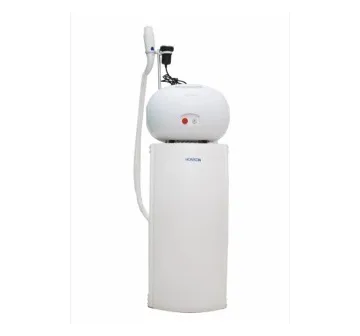
Pmise SM-01
Cavitation is the one body device nobody buys for a single appointment. It's a course machine — weekly visits, a tape measure, and a therapist with her hand on the head the whole time. That changes what you sell and how you staff the room.
What this platform does
You're not here for a frequency number, but for whether a cavitation head earns its floor space: how many bodies a week, how long each sits, what your therapist has to learn first.
This is a course machine: nobody books ultrasonic cavitation once. The commercial logic sits in a block of sessions sold up front, run weekly, reviewed with a tape measure rather than a mirror. Get that framing wrong at the consultation and you spend three months defending a result you never promised.
Technical detail
| Technology | Ultrasonic cavitation |
|---|---|
| Frequency | 40 kHz |
| Mode | Low-frequency non-focused ultrasound |
| RF handpiece | Included, 0.5-5 s duration |
| Downtime | None |
| Applications | Body contouring, slimming |
| Warranty | 12 months, lifetime maintenance |
How it works
Running one abdomen, in order
- Tape measure before anything else. Three fixed points — waist, umbilicus, one landmark below it. Same posture, same time of day, every visit. Circumference settles arguments at the end of a course.
- Clean skin, clean head. Wipe the area down and dry it. Wipe the handpiece with alcohol between clients — our slimming protocol sheet is explicit about it.
- Gel generously. Then gel again. Ultrasound crosses into tissue only through unbroken contact, and a 72mm tip drags a thin layer dry within minutes. Air gaps mean wasted energy and hot spots.
- Start low, then change the right dial. Open at the lowest setting the client is comfortable with. After ten minutes it is not a straight climb upward: the staged parameter sheet for the roller-and-vacuum slimming platform beside this head drops the main power a step for the second stretch — abdomen and buttock 10 to 8, thigh and upper arm 8 to 6 — while the suction frequency goes up, 3 to 4. Those dials belong to that platform, not this head, so take the direction rather than the digits: what you raise later is coverage pace, not energy.
- Keep the head moving. Slow overlapping passes across the block you've marked out, never parked. Burn complaints reaching our desk come almost entirely from a head left sitting on one spot.
- Stay off bone. Ribs, iliac crest, spine, knees. Tonucci and colleagues, in Aesthetic Plastic Surgery in 2014, listed pain around the bony areas among the adverse effects reported by twenty women treated with a low-frequency, low-intensity unit. Mark the boundaries first.
- Twenty to forty minutes per area. That band comes from the treatment manual of that same slimming platform; the cavitation head has no course sheet of its own, and the timings carry across because session length is set by client tolerance and diary slots, not by the energy form. Published protocols sit inside it: a 2021 PLOS ONE trial by Taha and co-workers ran 40 kHz cavitation at 45 W in 30-minute weekly sessions for twelve weeks, in fatty liver disease patients rather than clinic clients. Its title calls the ultrasound focused and we haven't verified the transducer type against this head, so borrow the 30-minute unit and nothing else.
- Water and a plain aftercare card. Our device manuals say the same three things: drink water, skip the shower for several hours, no sauna or heavy massage for a day. Hand the card over on paper.
One line to add to the script
Warn people about the sound: clients commonly notice a high-pitched tone, and if nobody mentioned it they assume the machine is faulty.
Applications and protocol
Five minutes of questions at the consult is what stops a complaint file three weeks later.
- Soft, diffuse subcutaneous fullness — abdomen, flanks, outer and inner thighs, upper arms
- Cellulite and orange-peel texture, where the complaint is surface as much as volume
- Post-pregnancy or post-liposuction contour tidying — only once healing is complete, breastfeeding has finished and the client's own doctor has signed her off. Front desk needs that: a post-natal enquiry and a breastfeeding client are often the same person.
- Clients who want visible progress between visits, not one dramatic appointment
- Anyone already moving and eating sensibly. A randomised trial in fatty liver disease patients — not aesthetic clients — found cavitation plus aerobic exercise beat exercise alone: an accelerator rather than a substitute, and not a result to quote
The screening list you keep beside the couch
Pregnancy and breastfeeding. Pacemakers, implanted defibrillators, any implanted electronics. Metal implants or bone pins inside the treatment field. Kidney stones. Uncontrolled hypertension, heart disease, severe diabetes, epilepsy, autoimmune disease. Active infection, broken skin, herpes, and any lesion in the area you can't confidently identify — refer or biopsy, never pass a head over it. Recent oral retinoid courses. Our archived contraindication sheet also flags menstruation and recent radiotherapy, and asks operators to have clients remove jewellery first. Use it as a screening anchor, not gospel; read this page as background rather than medical advice, because deciding who is a candidate is a job for a qualified practitioner.
Spacing a course, and what to run alongside
That same slimming-platform manual, not a cavitation-specific one, puts the interval at three to seven days and the course at ten to twelve treatments — two visits a week for the first fortnight, then weekly. That cadence is the business case: a dozen visits at a package price, with a review at the end.
A client who does nothing else is buying the weaker half of the protocol.
The unit ships an RF handpiece beside the cavitation heads, and our archived specification sheet lists skin tightening among its applications — enough to finish a course with. Laxity as the presenting complaint is a different job: for an abdomen that won't spring back after a fast drop in measurements, put a dedicated RF-01 radiofrequency platform on it. Wu and colleagues, in the Journal of Cosmetic Dermatology in 2025, alternated low-intensity focused ultrasound with radiofrequency across six sessions in six weeks with no adverse events. Their beam was focused and this 40 kHz head is not, so read it as evidence that sequencing ultrasound and RF is tolerated, not as a claim for the SM-01. For a discrete, pinchable bulge that cavitation passes straight over, CR-01 cryolipolysis is the better tool. Our body contouring overview sequences the three in one room.
Key advantages
What it actually costs to run
- Consumables are almost nothing. Gel. That's the whole list — no membranes, no lamps, no filters, no shot counter ticking towards a bill.
- Visit frequency is where the money is. Ten to twelve appointments per client per course, against a fat-freezing programme booking the same client a handful of times: our archive puts repeat cryolipolysis on the same site roughly two months apart, and CR-01 cryolipolysis carries the sources.
- Hands-on the whole time, though. Price for it: no unattended cycle, a therapist on that head for the full thirty minutes, one room and one client.
- The 72mm tip cuts both ways. Big footprint: an abdomen or a thigh goes quickly, small or awkward areas aren't this machine's territory.
- Air-cooled and compact. No water loop, no monthly fluid change, light enough to move between rooms, maintenance close to nil.
The room arithmetic
Nobody can hand you a payback figure: three of the four inputs are yours alone. Fill them from last month's real numbers.
- Revenue per client, per course = session price × course length, and course length is the one variable you don't have to invent: ten to twelve treatments, so a client is worth ten to twelve times your single-session price.
- Sessions per machine per week = (bookable hours per day ÷ (treatment time + room turnaround)) × trading days. Treatment time comes off the protocol above — 20 to 40 minutes per area, call it 30 for an abdomen. Time the turnaround with a stopwatch; don't estimate it.
- Realistic weekly take = sessions per week × session price × utilisation. Utilisation wrecks these calculations: a course-based device takes weeks to fill a diary.
- Payback, in months = purchase price ÷ (weekly take × 4 − therapist hours × your hourly wage cost − monthly gel spend). Weigh a fresh tub, count the abdomens it covers, divide.
Run it twice, at your hoped-for utilisation and at half of it. If only the optimistic version pays the machine off, you're buying a forecast.
Gel discipline is most of the training curve
Three things to learn: lay enough gel and keep laying it, move at a steady overlapping pace, stay clear of bone. At low settings the failure modes are that few, so a careful therapist is running supervised sessions inside a couple of days.
Consultation is where the money leaks instead. Keep the script dull: identical wording on timelines and measurements, an identical refusal to name a number, because the second a therapist freelances an estimate it becomes a promise. Log every session — area, settings, duration, operator. Commissioning, spares and warranty terms sit on our service page.
Frequently asked questions
How soon can we honestly tell a client they'll see something?
You can't give a date, and shouldn't invent one. What you can give is the published picture. Tonucci and colleagues ran five abdominal sessions on twenty women with a low-frequency, low-intensity unit and reported mean reductions of 1.5 cm at the waist, 2.1 cm on abdominal circumference and 1.9 cm at the umbilicus — alongside satisfaction rated only moderate and a significant rise in fasting glucose the authors said needs further study. Context, never a forecast.
Separate two things in the client's head, too: the redness after a session is a reaction, not a result.
Which reactions get a client phoning you the day after?
Warmth and redness over the treated block, settling within a few days per the same protocol sheet. Mild burning during the pass, tingling or one-sided numbness, a dull soreness afterwards — all on the adverse-effect list in that 2014 Aesthetic Plastic Surgery paper. None of it needs intervention, but people ring anyway, so put the card in their hands: shower can wait several hours, no sauna or vigorous massage for a day, go easy on greasy and spicy food for the week, keep drinking water, sun protection on any treated skin that sees daylight.
Which parts of this can a junior therapist own?
The session itself, yes — once she's signed off on gel discipline, pass speed and the bony landmarks. Screening is a separate job, and belongs with whoever is qualified to rule out the contraindications above.
Can you spec the room for us?
Tell us what your consultations surface, and your local voltage, through contact, and we'll spec the room before anything ships.
Where the published figures on this page come from
- Taha and co-workers, PLOS ONE, 2021 — title says focused and the transducer is unverified against this non-focused head, so used only for session length and the exercise comparison.
- Tonucci and colleagues, Aesthetic Plastic Surgery, 2014 — circumference figures, satisfaction rating, adverse effects and the fasting-glucose observation; twenty women, five abdominal sessions.
- Wu and colleagues, Journal of Cosmetic Dermatology, 2025 — focused ultrasound, not 40 kHz non-focused cavitation; used only for the sequencing question.
References
- Taha MM, Aneis YM, Mohamady HM, Alrasheedy SA, Elsayed SH. Effect of focused ultrasound cavitation augmented with aerobic exercise on abdominal and intrahepatic fat in patients with non-alcoholic fatty liver disease: a randomized controlled trial. PLOS ONE. 2021;16(4):e0250337 (40 kHz, 45 W, 30-minute sessions weekly for 12 weeks; titled focused ultrasound and transducer type not verified against the non-focused head on this page, so used only for session length; population = NAFLD patients, not aesthetic clients)
- Tonucci LB, Mourao DM, Ribeiro AQ, Bressan J. Noninvasive body contouring: biological and aesthetic effects of low-frequency, low-intensity ultrasound device. Aesthetic Plastic Surgery. 2014;38(5):959-967 (20 female subjects, 5 abdominal sessions; waist -1.5 cm, abdominal -2.1 cm, umbilical -1.9 cm; moderate satisfaction; significant increase in fasting glucose; 4 adverse effects)
- Wu Z, Wang Y, Li W, Zhang W, Zhu L. A clinical early evaluation of the combined use of low-intensity focused ultrasound and radiofrequency for female abdominal contouring. Journal of Cosmetic Dermatology. 2025 (6 sessions over 6 weeks, no adverse events reported; LIFU not 40 kHz non-focused cavitation)
Quote the Pmise SM-01.
Tell us your country and clinic type. We reply within 24 hours with technical detail, pricing and the spare-parts picture.