Acne & acne scars
Two different jobs hide behind one page. Calming skin that is still breaking out is not the same shift as rebuilding skin that already scarred, and your protocol, your intervals and your chair time all change depending on which one walks in.
What you are treating
Two different jobs hide behind one category: active acne is an inflammatory, bacterial, sebaceous problem, atrophic scarring a collagen problem left behind after it burned out.
Grade the acne before you touch a handpiece
Our documentation sorts acne into four grades: Grade I mostly comedones with a few papules, Grade II moderate papules and pustules, Grade III heavy papulopustular disease with a few nodules, Grade IV nodulocystic and conglobate. One thread runs through all four — the prescriber leads, the device assists, and nothing here substitutes for a topical or oral plan.
- Grade I — treat today, but not on your own. The jet-and-light program carries most of the visible workload here, but it isn't the whole plan: expect a maintenance topical from the client's own doctor alongside it. You clear the plugs and hold the schedule; you do not replace their medication.
- Grade II — treat today, same footing. Same program, longer course. The topical is doing more of the work, so the pitch is adjunct plus adherence, not cure.
- Grade III — drug and device in parallel, prescriber leads. The American Academy of Dermatology's 2024 acne guideline update leans on combination therapy, and the prescribing physician owns that plan.
- Grade IV — refer first, treat later or not at all. The same 2024 guidance points to oral isotretinoin for severe or treatment-resistant acne.
What the scar actually is
Atrophic acne scars are lost dermal collagen — icepick, boxcar, rolling — and our internal notes put the self-healing tendency at essentially nil. What does fade is post-inflammatory erythema and hyperpigmentation, which clients confuse with scarring. Stretch the skin under good light: a true atrophic scar keeps its shadow, a pigment mark does not. This page is operational guidance for equipment owners, not medical advice.
How the treatment works
Three mechanisms, three endpoints
The water and oxygen jet blows follicular plugs out mechanically: our engineering archive describes the working spray as 50 to 80 micron granules leaving the handpiece at around 200 m/s, which is why blackheads lift without an extraction tool and why an inflamed area may pinpoint-bleed — the intended endpoint on a pustular lesion, though you throttle the pressure once erythema outruns comfort. E-light works photothermally, its light end hitting the porphyrins and the vessels feeding the inflammation while the RF end heats the dermis without needing melanin contrast — our archive credits that RF with shrinking sebaceous gland activity over a course, which is why E-light suits darker skin where IPL alone is twitchy.
The fractional platforms punch columns and leave untreated skin between them, so healing runs from the sides inward. The CF-01 ultrapulse CO2 vaporises tissue at 10600 nm for the strongest remodeling per session; the EF-01 erbium glass coagulates without breaking the surface, trading depth for downtime and safety.
Density is the dial that decides your complication rate
In Fitzpatrick IV to VI, a 2016 split-face study in Dermatologic Surgery by Alexis and colleagues found scar improvement after higher- and lower-density non-ablative fractional treatment statistically similar, while five of seven patients in the higher-density arm developed mild or moderate hyperpigmentation against three of seven in the lower-density arm (abstract). No significance test is claimed on that difference, but the efficacy result is the point: same improvement, no reason to push density higher.
Our erbium glass parameter table sets mild to moderate atrophic acne scarring at a 2.0 × 2.0 cm square, 12 × 12 points per cm², two passes; deeper depressed scars move to a 1.0 × 1.0 cm square at the same spacing. For Fitzpatrick IV and above, drop one step on the density control, hold the two passes, and add a session or two to make up the coverage.
A realistic treatment protocol
Session one is a consult, not a treatment
Every time: confirm health status and open a file; photograph at fixed light, distance and angles; strip all make-up; then set the room up — protective eyewear on client and operator, ear plugs for jet work, and for CF-01 a mask, medical gloves and a filtered plume evacuator switched on before the first pass.
Then run a low-energy test on a discreet site. Our E-light sheet notes a light erythema fading within 5 to 10 minutes, so that reads in the same appointment; on EF-01 the endpoint is a pins-and-needles prickle on the inner forearm. Delayed reactions are the other kind — pigment darkens over the 72 hours after an E-light pass — so for Fitzpatrick IV and above, for anything ablative, and for anyone new to that machine, test as its own appointment and read at 72 hours, or day 7 before a full CF-01 field.
Screening rules out, or pushes to the prescribing physician: previous resurfacing or dermabrasion in the same field; botulinum toxin, E-light or RF there inside seven days; active skin disease, infection or inflammation; diabetes, smoking, any history of physical or hypertrophic scarring; recent retinoid use; serious systemic disease; pregnancy or breastfeeding; and any photosensitising medication. An atypical-looking lesion is a biopsy and referral, not a laser pass. Cold sores or facial herpes get their own line: a 2002 Dermatologic Surgery trial by Beeson and Rachel found no HSV outbreaks or recurrences under valacyclovir prophylaxis around facial resurfacing (abstract), so get the physician's instruction into the file before booking.
The active-acne cycle, and how it sits in the diary
Jet first, light second. Deep cleanse with the OJ-01 water oxygen jet, standoff doing most of the work: 0.3 to 0.5 cm to increase peeling, 5 to 10 cm on sensitive skin and around the eyes, output pressure inside 0.3 to 0.6 MPa. Then follow with PE-01 HPT E-light, whose acne sheet runs a row per skin type: roughly 40 to 48 J of IPL with a 1.0 to 1.5 second RF dwell at the lightest types, down to about 25 to 38 J with a 0.5 to 0.8 second dwell at type VI. Start at the bottom number of your client's row, log the exact figure, and move up one increment next session only if the last settled clean.
Our training manual sets the program at one session every 7 days, 8 to 10 sessions to a course, and names pairing the jet with E-light or RF as the combination that improves the acne result. The E-light sheet gives no session interval, so treat the weekly rhythm as a floor; the reaction curve is the real gate — white sebaceous material floats out over two to three days, the lesion is generally gone around day 7, the surface settles across roughly one to two weeks. Never re-treat before the last reaction has completely settled. Squeezing that material is forbidden throughout: hands off the lesions, let crust drop on its own, sunscreen at SPF 15 or above.
The scar cycle
Non-ablative fractional scar work is a course: two passes over the 2.0 × 2.0 cm square at 12 × 12 points per cm², three to six sessions three to four weeks apart, depressed scars on the 1.0 × 1.0 cm square. Our documents disagree — the EF-01 console manual schedules six sessions, 7 to 14 days apart, at higher energy with more passes into depressed areas. Pick one per client; don't blend them mid-course.
Ablative CO2 is a different commitment. Remodeling keeps running for twelve to eighteen months, so let a scar mature about a year before resurfacing; tissue may need a six-month healing cycle after an effective ultrapulse pass. Two limits operators break: no more than three passes per site, and no overlap between pattern shapes — hypopigmentation in our complication list is associated with spot overlap above 50% and more than three scans. On isotretinoin, the conservative six-month wait before ablative resurfacing is still mainstream, but the 2017 ASDS Guidelines Task Force consensus (Waldman et al., abstract) found insufficient evidence to justify delaying superficial peels and non-ablative lasers.
After a fractional session: what the client does, what you check
Two devices, two recovery cards.
EF-01, non-ablative 1550 nm (console manual and consent sheet). Hour 1: nothing unclean on the face. First 24 hours: no make-up. First 72 hours: no water above 60 degrees C, gentle cleanser only, no scrub, massage, salon exfoliation, alcohol-heavy or fragranced products, and no spicy food, seafood or lamb. From day 3: sunscreen at SPF 15 or above daily plus hydration; days 3 to 7 add hydrating and nutritional care morning and night. Never scratch, and have itch checked for infection. Normal timeline: redness and swelling settle within about 24 hours; erythema or a hive-like flush runs hours to days; microspot sites darken then fade within about 10 days; minor lightening resolves within about 30 days. Make-up returns at 24 hours, though the pattern shows up close for a week.
CF-01, ablative CO2, is an open wound. Normal curve, for the consult: our skin-reconstruction notes put post-operative edema at its peak around days 2 to 3 and mostly subsided by days 5 to 7, while erythema runs one to three months after CO2 against one to four weeks after short-pulse Er:YAG. Itch in week two is not part of that curve — the same source flags it for candida.
Wound care runs two routes. Closed dressing: on within about two hours, held at least 24 hours, changed every 24, off by 72, with foam removed by 48; the closed route is credited with re-epithelialization 30 to 45% faster and new collagen about three days earlier. Open: from day one, 0.25% acetic acid in iced distilled water about 20 minutes every one to two hours, occlusive ointment between soaks, thick crust off gently with saline and never picked. After 72 hours the wound is exposed and emollients run to about two weeks. Days 5 to 21, a low-potency topical steroid at bedtime for erythema, and broad-spectrum antibiotic cover from the night before for ten days — both prescriber decisions, in the file before booking. Once closed: neutral cleanser, daily moisturiser, sunscreen. Follow-up is day 1, day 3, week 1, week 3, week 6, month 3.
Downtime. The manual prints no number, only that timeline: no make-up and no public-facing work through the wound phase, then weeks of covering residual redness. Log the date the wound closed, the day make-up returned and the week redness stopped needing cover.
Call us today, in bold on both cards: pain that is new or worsening; burning or severe itch on day 2 or 3; patchy heavy redness; yellow discharge or crusting; pustules; erosion; a wound that was closing and has reopened. That is the infection picture from our documentation, answered with antibiotics for 10 to 14 days. Blisters or building swelling: same day, and they must not self-treat.
When it goes sideways
Persistent erythema after fractional work is usually self-limiting. Our complication list puts pigmentation appearing one to two months after ablative treatment, with strict sun avoidance as the first line, and calls depigmentation rare and late, from around six months out to twelve. A 2010 Dermatologic Surgery review by Metelitsa and Alster (abstract) notes complication risk climbing in sensitive cutaneous areas, in darker phototypes and with predisposing risk factors.
Choosing between the platforms
Which box does which job
The OJ-01 is the workhorse — no optical consumable, short appointment, sold as a weekly repeat — and the PE-01 earns its slot on utilisation, its quick-swap filters also serving hair removal, vascular and pigment work. Between the fractional systems the split is downtime and skin type: EF-01 at 1550 nm is the safer default for Fitzpatrick IV to VI, CF-01 at 10600 nm what you reach for on deep boxcar and rolling scars. The same pairing is covered on our scar treatment page.
Chair time and consumables
A full-face jet treatment is about 20 minutes of handpiece time, longer with lesion load, excluding cleansing, consult and room turnover. For CF-01: 2.5% lidocaine under plastic-film occlusion for 30 to 60 minutes, budgeted as room time. The manuals state no appointment length for full-face fractional, so log your own across thirty sessions: parameter row, interval booked and actual, handpiece and room minutes, and for CO2 the date of wound closure.
Consumables, itemised: the OJ-01 line. Per session: the liquid bottle refill (saline plus nutrient solution), medical oxygen with supply held at 0.8 to 1.2 MPa and output inside 0.3 to 0.6 MPa, one pair of disposable gloves, ear sponge, tissue, and the eye patch. Note what is not there — the handpiece and tip are reusable and disinfected between clients, a real cost difference against tip-based systems.
Consumables, itemised: the CF-01 line — the one most quotes leave half-costed.
- Plume control. Every ablative pass makes smoke, and blowing it off the field is not capturing it. A filtered evacuator is both a per-session running cost, filters having a finite life, and an operator-protection item at the level of the eyewear nobody would skip. Our documentation names no model and no filter interval, so take no number from us: specify a unit rated for surgical plume and get filter life and price in writing.
- Topical anaesthetic. CO2 is 2.5% lidocaine under film for 30 to 60 minutes; for EF-01 the console manual mentions a 9% lidocaine cream at 15 to 20 minutes, or an ELMA- or LMX-type cream wrapped for 20 to 60 minutes, then argues against routine anaesthesia because the client's prickling sensation is your endpoint. An hour under film is an hour of somebody's space, and not the laser room.
- Reusable, not disposable. The CO2 lens tubes are reusable, disinfected with 99% anhydrous alcohol ten minutes before treatment and dried before use; the 1550 lens cone is the same at 75% alcohol. No per-shot tip to buy on either.
- Wound-care stock, your cost and not the client's: sterile gauze, saline, 0.25% acetic acid solution, occlusive ointment, and dressings — composite foam, polymer film, mesh, hydrogel, hydrocolloid, alginate — changed daily across the first 72 hours. Cost a three-day set per CO2 case into the price.
Light platforms otherwise consume electricity, cooling and lamp or handpiece service life, as does the CO2 tube; ask for the service interval in writing. Training runs jet in days, E-light in weeks, fractional CO2 last and only with your most experienced operator or a physician. Our service and spare parts page lists what ships with the machine; for a bundle around a specific patient mix, tell us what you plan to treat.
Recommended equipment
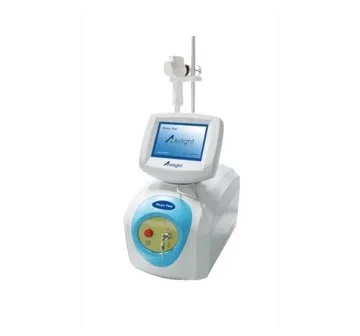
EF-01
1550nm non-ablative fractional laser for acne scars, fine lines and stretch marks.
View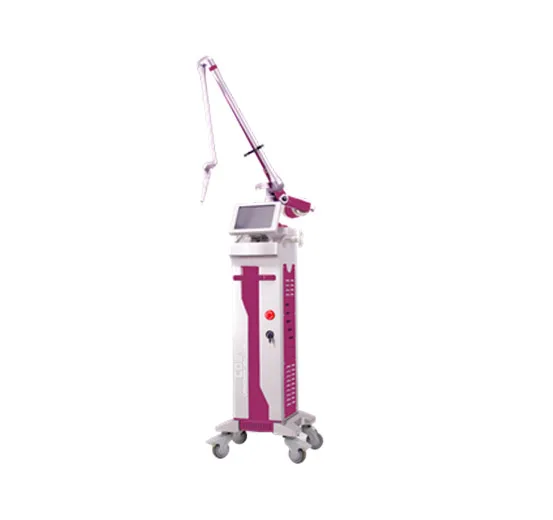
CF-01
10600nm ultrapulse CO2 fractional laser for scar revision, resurfacing and rejuvenation.
View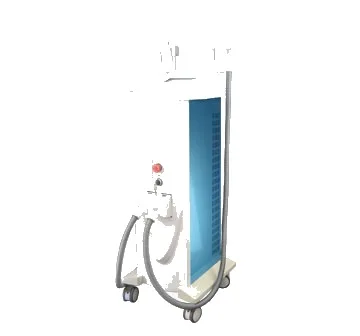
PE-01
High-performance E-light (HPT) platform with triple cooling and fast filter changes.
View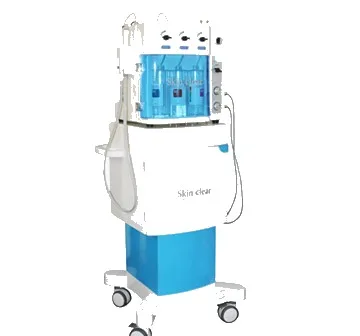
OJ-01
Water and oxygen jet for exfoliation, deep cleansing and serum delivery.
ViewFrequently asked questions
How much downtime do I quote for CO2 versus EF-01?
For EF-01, quote the manual: redness and swelling largely gone in about 24 hours, make-up back on at 24 hours, microspot marks fading over roughly 10 days. For CF-01 our manual gives a wound-care timeline, not a downtime figure: a wound phase at home, then weeks covering residual redness, which runs one to three months.
Can I treat active acne and acne scars in the same visit?
Generally no. Fractional work into actively inflamed, infected skin invites poor healing and pigment trouble. Control the inflammation first with the jet-and-light course, keep it stable, then start the scar course.
Is this safe on darker skin?
With the right platform and restrained settings, yes: non-ablative 1550 nm has published evidence in Fitzpatrick IV to VI, and E-light's RF works without relying on melanin contrast. But post-inflammatory hyperpigmentation is the default failure mode: drop a density step, start at the bottom of the client's E-light row, and be strict about sun protection. Ablative CO2 in type IV and above carries a much higher pigmentation risk. The same caution drives our melasma protocol.
References
- Alexis AF, Coley MK, Nijhawan RI, et al. Nonablative Fractional Laser Resurfacing for Acne Scarring in Patients With Fitzpatrick Skin Phototypes IV-VI. Dermatol Surg. 2016;42(3):392-402.
- Waldman A, Bolotin D, Arndt KA, et al. ASDS Guidelines Task Force: Consensus Recommendations Regarding the Safety of Lasers, Dermabrasion, Chemical Peels, Energy Devices, and Skin Surgery During and After Isotretinoin Use. Dermatol Surg. 2017;43(10):1249-1262.
- Beeson WH, Rachel JD. Valacyclovir prophylaxis for herpes simplex virus infection or infection recurrence following laser skin resurfacing. Dermatol Surg. 2002;28(4):331-336.
- Metelitsa AI, Alster TS. Fractionated laser skin resurfacing treatment complications: a review. Dermatol Surg. 2010;36(3):299-306.
- American Academy of Dermatology. American Academy of Dermatology issues updated guidelines for the management of acne (January 31, 2024).
Build a treatment bundle.
Get a quote for the machines behind this solution, configured to your clinic and market.