Scar treatment
Scar work is not one treatment with one setting. Which scar type you are looking at decides which console you fire, how many passes your technician dares take, and whether you should be treating this patient at all yet.
What you are treating
Scar revision is the most misjudged line on a clinic menu. It goes wrong when somebody treats the wrong kind of scar, or the right kind too early.
Three end states, one healing cascade
Every scar is the finished product of the same sequence — inflammation, then proliferation, then remodeling. Our internal dermatology training material follows that cascade to three results: hypertrophic, keloid, atrophic. Your consult has to land on one of them before anybody touches a foot switch.
The short version, for the consult room wall
| Scar type | How you recognise it | The call | Platform |
|---|---|---|---|
| Atrophic | Saucer-shaped or ice-pick depressions inside the injured area. Follows cystic acne and chickenpox. Little tendency to fill in on its own. | Your laser case — once the scar has matured. | CF-01 or EF-01 |
| Hypertrophic | Appears inside the first month. Stays within the original wound margin. Red, raised, firm, itchy. Sites under constant tension or repeated stretching are the usual offenders. May soften over years. | A vascular target, not a resurfacing target. Also a contraindication for ablative work. | PE-01, 585 nm filter |
| Keloid | Surfaces weeks to years later. Grows past the wound margin as purple-red nodules — earlobe, chest, shoulder, back. Does not settle on its own. | Stop sign. Silicone and pressure first, then a physician. | Refer |
What the history tells you
Two questions earn their keep at consult. How old is this scar? And has anyone treated it before? Fresh scars look redder than they will in a year, and scars already worked on elsewhere are harder to shift. Ask what was used, on what settings if they know, and how long ago.
Everything on this page is operator education, not medical advice. Every treat-or-refer call belongs to the licensed clinician running the device.
How the treatment works
Micro-columns, and the rim around each one
Fractional delivery puts down a grid of tiny wounds and deliberately leaves untouched skin between them. Each focal spot vaporises or heats a narrow column; around that column sits a shell of coagulated tissue, and around that a zone of milder thermal effect. The intact bridges between columns are what let the surface close quickly instead of scabbing over as one sheet.
Pulse width governs how thick that coagulation shell gets. Short pulse, thin shell. Long pulse, more cooked tissue around every hole. Our internal notes on light-tissue interaction set the threshold: past roughly a couple of hundred microns of coagulation, the tissue stops re-epithelialising cleanly and heals as scar. Push density and pulse width together and the coagulated rims start bridging into each other, which costs you the intact bridges and takes tissue away in a block.
Ablative or non-ablative: choose on downtime, not on ambition
Ablative fractional work removes tissue and gets you the biggest single-session change. Non-ablative fractional heats the dermis without breaking the surface, builds collagen across a course, and carries far less pigment risk on darker skin. They serve different patients and different calendars.
A 2014 consensus report in JAMA Dermatology argued that ablative fractional resurfacing deserves a prominent role in scar treatment and remains vastly underused, including early intervention to head off contracture. The 2020 international consensus recommendations published in Lasers in Surgery and Medicine went further and called lasers a first-line therapy for traumatic scars and contractures.
What the laser is not going to fix
Raised and red is a different problem from depressed. For hypertrophic scars and keloids the scar-management guidelines published by Monstrey and colleagues still put silicone sheeting or gel first, with pressure garments for widespread scarring after burns. Our own training archive points that work toward vascular-targeting light rather than an ablative platform.
A realistic treatment protocol
The consult: what stops the booking, and what only delays it
Our device manuals do not treat every entry alike. Sort them into two columns before anybody is quoted a price.
Absolute — do not treat, refer: keloid tendency or a strong hypertrophic scar history; pregnancy; active infection in the field; immunosuppression or current immunosuppressant medication; recent ablative resurfacing over the same field.
Relative — treatable, once someone has dealt with it.
- Herpes history: prophylactic antiviral cover started before the session and prescribed by the treating physician — not a cancelled booking.
- Diabetes: the manuals flag poorly controlled diabetes. Where control is good, get recent figures into the chart and delayed healing into the consent.
- Tattoo in the treatment area: map it and work around it rather than dropping the case.
- Vitiligo or psoriasis: warn about the Koebner response in writing, then a small test area before a full field.
- Fitzpatrick type: record it in the chart. Types IV to VI default to the EF-01 1550nm route; if CO2 is still the plan, drop energy and density together and have the treating physician sign it off.
- Recent sun exposure or tanning: defer according to your clinic's written protocol, and record the date of last exposure on the consent form. Our handbook sets no number of weeks, so do not invent one.
- Isotretinoin: our CO2 handbook lists use within the past one to two years among the situations that can heal abnormally. The 2017 ASDS task force consensus found insufficient evidence to justify delaying non-ablative and fractional ablative procedures after isotretinoin, while fully ablative resurfacing and mechanical dermabrasion stayed off the recommended list. The call belongs to the treating physician, not to a front-desk policy.
Photograph front, side and oblique under the same light every visit.
Collagen remodeling inside an atrophic scar keeps running for twelve to eighteen months after the injury, so our clinical archive advises holding ablative revision until the scar has had that first year to mature. Fresh surgical or burn cases belong with the treating surgeon.
Passes: a hard ceiling of three on any patch of skin
Fire a test on the test card first, then a low-energy test patch on the inner forearm, as the handbook specifies, and read that tissue reaction before anything else. Only once the forearm patch has behaved do you move to the treatment area, starting at the forehead — it tolerates energy well and shows your operator the day's tissue reaction.
- Mild damage and light scarring: one pass. Lower energy, denser pattern. Leave the dry epidermal debris in place; it acts as a biological dressing, improves hydration, and reduces pain and infection risk.
- Moderate atrophic scarring: pass one across the whole field. Wipe the debris away with saline gauze. Pass two full-field, dropping spot density if you want a shorter healing time. Then, on the deeper scars only, top up to a cumulative total of three passes on that skin — three in all, not three more.
- Severe scarring: full-field pass one, wipe, full-field pass two, then a third pass restricted to what still needs it — glabella, perioral, mid-cheek. Feathering the scar edges flat with a larger spot at lower energy happens inside that third pass, not after it.
Two areas break the pattern. The jawline gets one pass, full stop — the site most prone to complications and to hypopigmented scarring. Periorbital skin gets lower energy and no more than two passes total, smoothing shot included; treat the cheek before you go near the orbit.
The stop signs your junior operator must know cold
The wrinkle or scar has clinically disappeared. The tissue turns yellow-brown and the colour stays after you wipe with saline gauze — that is thermal necrosis, not debris. Or the tissue simply stops contracting under the beam. Any one of those and you leave that area and move on.
No patch of skin gets more than three passes in a session, and that count includes feathering, smoothing shots and localised top-ups; our handbook sets the ceiling in exactly those words.
And do not overlap — not the patterns, not the spots inside a pattern. Excessive overlap produces deep necrotic wounds that heal as scar, and late hypopigmentation at six to twelve months is associated in our documentation with overlap above half and with more than three scans.
The fortnight that decides your review
Closed dressing goes on within about two hours and stays at least twenty-four; applied later it does almost nothing. Our wound-care documentation credits occlusion with faster re-epithelialisation, less pain and inflammation, and earlier collagen formation than leaving the wound open. After that, soak-and-ointment tapering as the surface closes, then bland cleanser, moisturiser and daily sunscreen.
Oedema peaks at two to three days and mostly settles inside a week. Erythema hangs around and is normal. Itching in the second week means suspect infection until proven otherwise — as do new pain, yellow exudate, pustules or a wound that starts going backwards. Pigment darkening tends to appear one to two months out and is managed with strict sun avoidance and a physician-directed lightening regimen.
Spacing a course
On the ablative side, plan one to three rounds and no more: improvement keeps accruing for twelve to eighteen months after each session, so a second round on the same field waits roughly half a year, and a third only if the three-month photographs argue for it. Our archive puts ultrapulse CO2 improvement on moderate atrophic scarring at fifty to eighty-five percent, with the remodeling holding for years.
Non-ablative runs on a different clock. The 1550 nm course sheet in our archive sets atrophic scarring at six sessions spaced seven to fourteen days apart. If the skin is still pink at the booked date, push it out.
Book the review at the time of the first treatment. Our CO2 handbook schedules follow-up at day one, day three, week one, week three, week six and month three — six contacts, the last of which is where the collagen result shows.
Choosing between the platforms
Atrophic, sorted by sub-type
"Atrophic" on the consent form hides three problems that do not respond alike.
- Rolling. Broad, soft, shadowy dips with sloping edges. They are tethered from underneath, so energy delivered at the surface pulls against an anchor. A laser-only clinic tends to plateau here after two or three rounds; worth a physician conversation about releasing the tether before selling a package.
- Boxcar. Sharp walls, flat floor, well demarcated. The sub-type that rewards ablative fractional work most reliably, and our handbook is specific: treat a depressed scar at its rim, not its floor, with a larger spot walked around the edge.
- Ice-pick. Narrow tracts running deep, sometimes down toward subcutaneous tissue. A systematic review of energy-based acne scar treatments in Scars, Burns and Healing reports fractional Er:glass performing poorly against ice-pick and boxcar specifically, with ice-pick the least responsive sub-type overall. A fractional column at the CF-01's 0.1 to 2.0 mm spot range may simply never reach the base of the tract. TCA CROSS — focal high-strength trichloroacetic acid dropped into each pit — exists for exactly these scars, and it is physician work, not a technician add-on. Quote ice-pick cases as combination cases, or refer them out.
Downtime and phototype decide which of the two platforms the case goes to — worked through in full on the acne and acne scars page.
Raised and red: why this never goes on an ablative console
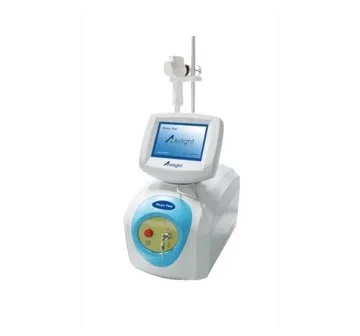
Hypertrophic scars and keloids are a vascular problem wearing a texture problem's clothes. Our archive routes them to a 585 nm-filtered head on the PE-01 HPT E-light platform, not to a resurfacing laser, because the target is the vessel feeding the scar rather than the collagen bulk sitting on top of it. Four operating notes from that same archive:
- Place the spots immediately adjacent but never overlapping.
- Drop the fluence on darker skin and on thin or fragile sites.
- The patient should feel a distinct sting; no sting usually means under-dosing and a session that does nothing.
- No epidermal cooling during the shot — the local thermal effect is meant to run on for twenty to fifty minutes afterwards. A cold compress after is fine for the pain.
Warn the patient about purpura for a few days, swelling inside forty-eight hours, and post-inflammatory hyperpigmentation, which our documentation handles with continued sun protection, continued treatment of the area until it clears, and longer intervals between sessions. And a keloid does not go on the CO2 to be "smoothed": keloid tendency is a listed contraindication for ablative resurfacing, and a keloid that reacts badly to your laser comes back bigger.
Room math nobody puts in the quotation
- Numbing: 30 to 60 minutes. Our CO2 handbook calls for topical anaesthetic under occlusive film for that long — occlusion also raises the water content of the skin, which matters for a wavelength this thirsty. Your own anaesthetic's label beats our number.
- Set-up: roughly 10 minutes. Consent, standardised photographs, alcohol-wiping the lens cone (the handbook wants that done ten minutes ahead), a 30-second console warm-up, test card, then a low-energy test on the inner forearm.
- Lasing: the short part. Two full-field passes at moderate density, saline wipe-downs between, plus localised top-ups inside the three-pass ceiling. Time your own console at your standard pattern and scan area, then write that number on the protocol sheet.
- Finish: 15 to 20 minutes. Cooling, a gentle water-oxygen clean of the field with the OJ-01 water-oxygen jet, the first dressing, and the aftercare briefing.
Block two hours of room time per case. Move the numbing to a second chair and one operator on one console clears three to four full-face cases in a working day; keep the numbing in the laser room and you are down to two.
Per-session consumables, worth costing at your own local rates. Topical anaesthetic — a full face burns through more of it than any new technician predicts — plus the occlusive film. Sterile saline, gauze and cotton swabs for wiping debris between passes. Patient eye shields. Then the take-home kit our handbook specifies: cool dilute acetic acid soaks for about twenty minutes every one to two hours, a petrolatum or lanolin-type ointment kept continuously over the soaked skin, and a dressing changed every twenty-four hours for no more than three days.
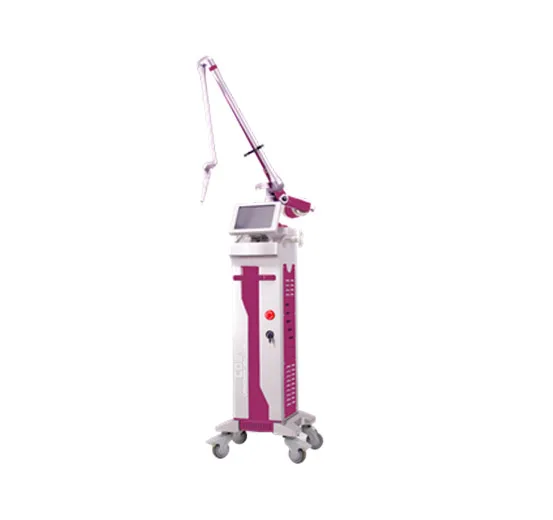
The CF-01 CO2 fractional laser and EF-01 1550nm fractional laser ship with a twelve-month warranty and lifetime maintenance support; full terms sit with our service team, who also handle installation training.
Frequently asked questions
Can we treat keloids with a fractional laser?
Not as a first move, and not on a technician's judgement. Keloid tendency sits on the contraindication list for ablative resurfacing in our own documentation, and the guidelines cited above put silicone and pressure ahead of device work. Refer the patient.
How many sessions do we quote, and how do we price the course?
Price the course, never the session. Non-ablative: the course sheet above gives six sessions at seven to fourteen day intervals, so sell a block of six with the three-month photo review inside the price. The same archive notes that around eight in ten acne-scar patients are satisfied by the second session, so review at two and be willing to stop early.
Ablative: one to three rounds, roughly half a year apart. Package round one with the six follow-up contacts and the month-three photographs in a single price; quote round two only off those photographs.
How long before a new technician is safe on scar cases?
Longer than on hair removal, because reading tissue takes weeks. Start new operators on body areas and forehead, cap them at a single pass, and keep a senior clinician on the jawline and orbit.
What is the single most common operator mistake?
Overlap — invisible in the moment and expensive six months later. Second, miscounting passes: treating the deep scars "twice more" on top of two full-face rounds. Third, treating a scar that was never a laser case.
References
- Anderson RR, Donelan MB, Hivnor C, Greeson E, Ross EV, Shumaker PR, Uebelhoer NS, Waibel JS. Laser treatment of traumatic scars with an emphasis on ablative fractional laser resurfacing: consensus report. JAMA Dermatol. 2014;150(2):187-193.
- Seago M, Shumaker PR, Spring LK, et al. Laser Treatment of Traumatic Scars and Contractures: 2020 International Consensus Recommendations. Lasers Surg Med. 2020;52(2):96-116.
- Monstrey S, Middelkoop E, Vranckx JJ, et al. Updated scar management practical guidelines: non-invasive and invasive measures. J Plast Reconstr Aesthet Surg. 2014;67(8):1017-1025.
- Waldman A, et al. ASDS Guidelines Task Force: Consensus Recommendations Regarding the Safety of Lasers, Dermabrasion, Chemical Peels, Energy Devices, and Skin Surgery During and After Isotretinoin Use. Dermatol Surg. 2017.
- Kravvas G, Al-Niaimi F. A systematic review of treatments for acne scarring. Part 2: Energy-based techniques. Scars Burn Heal. 2018;4:2059513118793420.
- Bhardwaj D, Khunger N. An Assessment of the Efficacy and Safety of CROSS Technique with 100% TCA in the Management of Ice Pick Acne Scars. J Cutan Aesthet Surg. 2010;3(2):93-96.
Build a treatment bundle.
Get a quote for the machines behind this solution, configured to your clinic and market.