Freckle removal
Freckles are the fastest pigment win on your price list and the easiest one to oversell. This page is about running the session and the diary, not comparing spec sheets.
Who is actually sitting in your chair
Freckles are pulsed-light work: filtered IPL or E-light with sapphire contact cooling does the bulk, and a Q-switched console picks off what survives two rounds. Three to five sessions, 28 to 45 days apart. Our manuals put roughly 70% of the outcome on treatment and the rest on sun protection.
Now the person in the chair. Easiest consult of your week, and the easiest to get wrong. A scatter of small yellow-brown macules across nose and cheeks, there since primary school, darker every August. Our internal dermatology reference has ephelides in exactly those terms: 1 to 2mm spots on sun-exposed sites, first showing at five to ten years old, season-linked, flat, with the epidermal melanocyte count raised on histology. The pigment sits shallow. That is why the indication is quick, and why she expects it to be cheap.
They will come back, and that is not a failure
Ephelides are genetically loaded and sun-triggered. Bastiaens and colleagues, in Human Molecular Genetics (2001), put the risk at roughly threefold with one MC1R variant and elevenfold with two (PubMed 11487574). Praetorius, Sturm and Steingrimsson drew the line in Pigment Cell & Melanoma Research: ephelides are genetically determined but sun-induced, lentigines come out of accumulated photodamage (PubMed 24517859). You clear this season's pigment from a face built to make more.
Three brown things that are not the same
Freckles, lentigines and melasma all read as spots from the doorway and behave nothing alike under light. Melasma flares from heat about as readily as it fades, so freckle energies risk driving that pigment darker — hence the conservative programme on our melasma page. Anything asymmetric, changing, or that you cannot confidently name goes to a dermatologist before a single flash; our manuals list undiagnosed lesions as a hard contraindication. What follows is operational guidance for trained clinic staff, not medical advice, and local rules decide who may legally operate this equipment.
Which handpiece you reach for first
Filtered pulsed light carries the bulk of this work
Our internal reference is blunt on ephelides: intense pulsed light is first choice, E-light the other strong option because it adds radio frequency over the same filtered spectrum. Coverage is why. Freckles turn up as a scattered field, not three tidy targets. Our archived handpiece set runs 10 x 10mm, 8 x 40mm and 15 x 60mm. You sweep a face with the 8 x 40mm cartridge window; the 15 x 60mm head is a hair tip, so park it. Take one cheek. That window covers it in a few dozen shots. A millimetre-scale laser spot on the same cheek is not sweeping at all — it is one shot per freckle, several hundred of them. The wrist is the bottleneck, not the machine.
The cooling rule nobody reads
One line from our light-and-tissue training material decides whether your passes work at all. Every modality except Q-switched needs epidermal cooling on these lesions, and on long-pulse devices like IPL and E-light, running without it can leave you with no clinical effect at all. Sapphire contact cooling is not comfort trim. It lets you push energy into a shallow target without cooking the surface above it. Confirm the tip is genuinely cold before the first client — our commissioning routine has the operator power-cycle the console and touch the head.
Where the Q-switched console earns its slot
Some spots refuse to answer pulsed light. Wang and colleagues ran a physician-blinded split-face trial in the Journal of the American Academy of Dermatology in 2006: one Q-switched alexandrite session on one cheek against two IPL sessions four weeks apart on the other. Freckles improved significantly more on the laser side, and the laser side was also where the PIH turned up (PubMed 16635661). Different wavelength from ours, same lesson: a nanosecond pulse clears harder and punishes carelessness harder. Keep the QN-03 for dark spots still standing after two pulsed-light rounds, treating those as individual targets rather than a field — same console you already use for tattoo work.
One session, start to finish
Screening, and the things people forget to ask
Run the contraindication list out loud, every time, off the sheet in our manuals: photosensitising medication such as tetracycline, any lesion without a firm diagnosis, pacemakers or related implants, serious diabetes, hypertension, heart disease or epilepsy, keloid tendency, pregnancy, and treatment immediately before or after sun exposure. That last one catches people out — a client who spent the weekend on a boat is a rebooking, not a discount.
That is the manual's list. Clinics add four of their own, and you should: isotretinoin now or recently, because skin heals differently on it; active herpes simplex or infection in the field, which a facial pass can spread; a peel or self-tanner inside two weeks, both of which change what the epidermis absorbs; and tattoos or semi-permanent make-up in the field, which take up light hard and blister. Two more before she sits down — contact lenses out, lash extensions declared. On E-light platforms the RF means metal jewellery comes off first. Photograph under fixed lighting, write the parameters into the record, get a signature — in month four that file settles the argument about January.
The pass itself
- Goggles on, both of you, before any flash — opaque IPL eyewear covering the full 480 to 1200nm output, not tinted salon glasses. For the cheekbone and forehead passes, swap hers for opaque single-use adhesive external eye shields over closed lids, so the orbital rim stays covered. Metal corneal shields sit under topical anaesthetic and are placed by a licensed clinician — if your protocol calls for them, that step is not the therapist's. Treat up to the orbital rim, never inside it: brows and upper lids are not a treatment area, whatever the freckles on them look like.
- Cleanse with a mild milk and dry the skin. Shave any hair in the field.
- Set starting parameters by Fitzpatrick type, not by feel. Our archived pigment tables run about 4 to 5 pulses with a 6.0 to 10.0ms first pulse and 40 to 48 J at type I, tightening to 2 to 3 pulses, 2.8 to 3.6ms and 25 to 38 J by type V, with RF time stepping down alongside. There is no type VI row, and that is a rule rather than a gap. Never extrapolate the type V line downward. A type VI client does not get pulsed light on this platform — rebook her onto something else or refer her out. Inside the table, type IV and V start at the bottom of their row rather than the middle, and their interval goes toward the 45 day end, because PIH risk climbs with baseline melanin.
- Gel about 2mm thick across half the face, treat it, then gel the other half — half at a time gives her a live mirror comparison.
- Flash three times into the air to confirm output, then two or three test shots on the chin or under the earlobe, and wait. Faint pink over the next couple of minutes is your green light. Frank redness means take the energy down before the handpiece goes near her cheeks.
- Work bottom to top, outside to inside. On one cheek that reads as stacked rows of the 8 x 40mm window running out toward the ear, each row biting about a third into the one below it. Press the head close and lift the skin slightly so light does not leak at the nose wing, cheekbone and forehead — that is where burns happen, and where the row stops at the orbital rim. Over a darker cluster, drop a joule or two rather than powering through.
- Pause every four or five flashes and look, giving each shot three to five seconds first. You are deciding whether this pass carries on up onto the cheekbone. Red, then light red, then normal says yes. Light red climbing to red, then deep red, then a mauve cast she can feel as heat says no — cool that area now and stop. And ask how it feels, out loud. You cannot read a parameter off a face.
Endpoint, aftercare, and the interval you will be argued with about
The endpoint: spots darkening and floating toward the surface, skin lightly red and slightly warm, pores looking tighter. That is it. You are not chasing blistering or blanching.
What she sees next, from our post-operative notes: stinging, light redness clearing in one to two hours, pigment darkening within roughly 72 hours, then metabolising away over about ten days. Second session, milder sting and usually no floating pigment at all.
Aftercare rules worth printing on a card. Moisturise; no sun; no hot water; no treatment cosmetics on the area. Mild cleanser from day two or three, basic skincare from day ten. Do not scratch, however itchy the floating pigment gets. Redness still there after three hours, cool the skin. Blistering goes to a licensed clinician, not your therapist. And repeat the 70-30 line at the door.
PIH shows up at the follow-up, not on the table: compare the two to four week review photographs against baseline. If a treated area has darkened, hold the next flash — push the interval to the 45 day end or beyond until the colour stops moving. A second pass does not cover PIH up. Treat that area again only from the bottom of her Fitzpatrick row, energy dropped. Waiting plus daily sun protection is the main line, not a therapist reaching for a product. Refer to a licensed clinician if it keeps deepening at the next review or spreads beyond the treated spots.
Interval is 28 to 45 days, and clients push for faster. The answer is no. Crowding sessions on a sun-exposed face buys you a PIH case instead of a testimonial.
Chair time, consumables and who you let hold the handpiece
What a freckle session does to your hour
The flashing is the short part — at a 3 second discharge interval, a full face is minutes of it. What fills the slot is everything else: screening, photographs, eyewear, cleanse and shave, gel on and off, observation pauses, the aftercare talk. Most of an hour, all in — three or four in an afternoon, never a fifteen-minute add-on.
Consumables are boring: gel, purified water, cleansing supplies. The flashlamp is the real long-run cost, and it is rated in flashes rather than years. Our maintenance documentation for this platform puts the pulsed xenon lamp near 60,000 flashes, with high-fluence hair work usually falling short of its endpoint by around 30,000 as output drifts down. So pick your divisor by what the room runs: 60,000 on a pigment-led diary, nearer 30,000 where a hair schedule shares the console. Log the counter at every change. Our notes also want the filter cleaned every 7 to 15 days in the first months. Skip it and output drops quietly — it shows up as a therapist creeping the energy upward.
Which console, and in which room
If freckles, sun spots and photorejuvenation are the bulk of your pigment work, one E-light platform covers it. The MF-05 gives you the filter set, the RF pairing and triple contact cooling in one console. Choose the PE-01 when a heavy hair diary justifies it. Freckle work runs the 8 x 40mm cartridge head behind the SR filter from 530nm; the 15 x 60mm window is a hair head only. What the PE-01 genuinely adds is HPT: a discharge holding roughly constant output for its full length, so a second-year therapist lands on your lead operator's endpoint off the same parameter row.
Add a Q-switched console once your pigment mix widens past ephelides. The QN-03 covers residual dark spots plus tattoos and carbon peel, and that carbon mode fills schedule gaps with a paid express treatment. Step up to the QE-01 only if dermal pigment and layered ink are on your list. Already own a Q-switched console and no pulsed-light platform? Don't add a second machine for ephelides — work one shot per freckle, accept the slower slot, and let the QN-03 page settle wavelength and spot size.
Training curve, and how to price the course
Good first indication to learn on, bad one to leave unsupervised early. The failure modes are quiet: the client who tanned last weekend, the cluster that runs darker, light leaking at the nose wing or drifting inside the orbital rim, a tip assumed cold because the machine is on. Sign somebody off when they call the endpoint unprompted and screen contraindications without the sheet — a handful of supervised real faces, not a certificate date.
Now the money. One session costs the therapist's slot — charge the whole hour — plus gel and cleansing consumables, plus lamp price divided by the divisor above, times your shots per face. Apply whatever margin your market carries and that is the range you quote from. Payback is console price divided by gross margin per session times the slots you can realistically fill in a month — and that only holds on a pigment-led diary. Ask us about operator training and spares, or talk to the team before the machine ships.
Recommended equipment
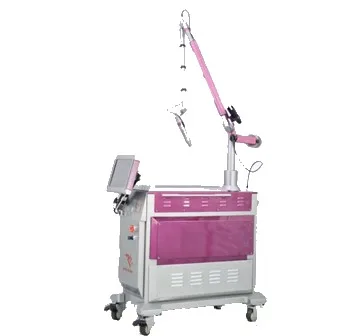
QN-03
1064/532nm Q-switched Nd:YAG for tattoos, pigment and carbon peel mode.
View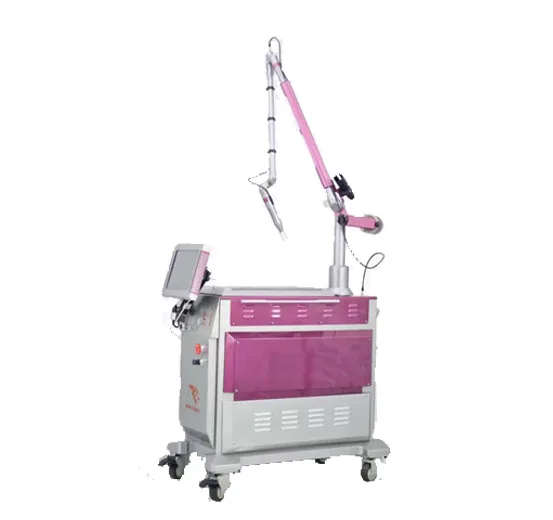
QE-01
Dual 1064/532nm nanosecond pulses for tattoo removal, nevus of Ota and pigment.
View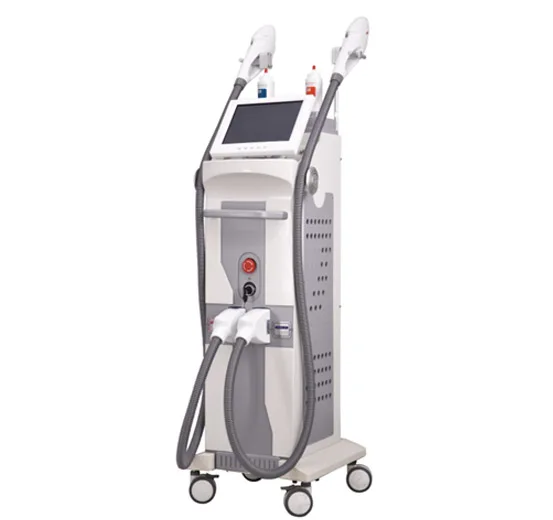
MF-05
IPL + RF console for hair removal, photorejuvenation, pigment and vascular work.
ViewFrequently asked questions
How many sessions should I book, and how far apart?
Three to five, spaced 28 to 45 days, off the pigment rows in the E-light parameter tables we hold for this platform. Published evidence sits inside that range — the split-face trial behind this page got meaningful improvement from two IPL sessions four weeks apart (PubMed 16635661). Pale and sparse often finishes at two or three; a dense field across both cheeks gets quoted at four or five. Bill per session off the cost sum above, quote a range, never a fixed-price package for total clearance.
What is a normal reaction, and when do I actually worry?
Normal is stinging during the pass, light redness gone within one to two hours, spots darkening over about 72 hours, then fading over roughly ten days. Itching as the pigment lifts is normal too. Scratching is not. Worry when redness outlasts three hours, when the skin goes deep red or mauve with heat mid-session, or when blisters form. Stop, cool, cover, record it, cancel rather than reschedule. Blister management is a clinical procedure, not a therapist's job.
IPL or the Q-switched laser, if I can only buy one?
Pulsed light first, and not because it clears harder. It doesn't. In that randomised split-face trial freckles came out significantly cleaner on the Q-switched alexandrite side (PubMed 16635661). Safety ran the other way, narrowly: one PIH case among the 15 freckle patients on the laser side, none on the pulsed-light side. The 8 PIH cases you will see quoted off that paper were its lentigines group, not the freckles. Buy pulsed light first for coverage across a scattered field and for the hair and vascular days the same console fills. The laser second, for the residue and the tattoo work it opens up.
Her freckles are back after the summer. Did the treatment fail?
Probably not, and it is a consult problem rather than a clinical one. A face that made ephelides at eight will make them again given enough UV. Treatment clears what is there; daily broad-spectrum protection holds it. That is the 70-30 line — useful to have said in January when she is in front of you in September.
References
- Wang CC, Sue YM, Yang CH, Chen CK. A comparison of Q-switched alexandrite laser and intense pulsed light for the treatment of freckles and lentigines in Asian persons: a randomized, physician-blinded, split-face comparative trial. J Am Acad Dermatol. 2006. (15 freckle and 17 lentigines patients; one QSAL session vs two IPL sessions at 4-week intervals; PIH in 1 freckle and 8 lentigines patients after QSAL, none after IPL.)
- Bastiaens M, ter Huurne J, Gruis N, Bergman W, Westendorp R, Vermeer BJ, Bouwes Bavinck JN. The melanocortin-1-receptor gene is the major freckle gene. Hum Mol Genet. 2001. (3-fold risk with one MC1R variant, 11-fold with two; population attributable risk 60%.)
- Praetorius C, Sturm RA, Steingrimsson E. Sun-induced freckling: ephelides and solar lentigines. Pigment Cell Melanoma Res. 2014;27(3):339-350.
Build a treatment bundle.
Get a quote for the machines behind this solution, configured to your clinic and market.