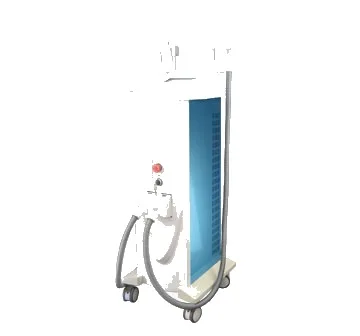
Pmise PE-01
The PE-01 is the big-window version of our E-light platform. Its 15 x 60 mm HR handpiece covers close to three times the skin of a standard cartridge per discharge, and that, not the trigger speed, is what shortens a leg. This page is about running a session, spacing a course and counting shots.
Who the PE-01 is actually for
The PE-01 is an HPT E-light platform — intense pulsed light (IPL) filtered through a cartridge set, fired together with bipolar radio frequency — and as a hair removal machine it lives or dies on window size and pulse consistency.
HPT is a pulse-shape claim about time, not area: the factory literature describes homogeneous power held across a long pulse duration, so the discharge holds roughly constant output for its whole length instead of spiking early and trailing off.
The filter set spans 480 to 1200 nm: HR from 610 nm for hair, VR from 585 nm for vessels, SR from 530 nm for pigment and rejuvenation. The big 15 x 60 mm HR head is a hair head only; everything else runs on the 8 x 40 mm cartridge.
This is operator education, not medical advice; the licensed clinician in your room owns every clinical call.
Technical detail
| Wavelength | 480 to 1200 nm (filter set) |
|---|---|
| Technology | HPT E-light (IPL + RF) |
| Spot size | 15 x 60 mm HR handpiece; 8 x 40 mm |
| Pulse train | 1 to 10 sub-pulses, programmable delay |
| Cooling | Triple contact cooling |
| Skin types | Fitzpatrick I to V for hair and pigment |
| Filters | Quick-change cartridges |
| Applications | Hair, pigment, vascular, acne |
| Warranty | 12 months, lifetime maintenance |
What HPT changes at the handpiece
Every parameter here comes from the PE-01 manuals and our Fitzpatrick parameter tables — factory starting points, not trial data.
Light first, current second
Optical energy goes in, RF follows through the same window. Melanin or oxyhaemoglobin absorbs the light, that target climbs above the tissue around it, and warm tissue conducts current more readily — so the RF concentrates where the light already sorted, reaching an endpoint at optical energies that wouldn't get there alone.
The pulse train is the control most operators underuse: one to ten sub-pulses with programmable delays, and those delays are cooling time for the epidermis while the follicle holds its heat. A Fitzpatrick I client gets eight to ten sub-pulses of seven to fifteen milliseconds each; a type V gets four to seven at around three.
Two things aren't negotiable. Gel goes on about 2 mm thick and evenly — it's the RF conduction path, not just an optical couplant. And the window presses flat in full contact, no light leaking at the edges; nose wings, cheekbones and the forehead are where operators lose that seal, which keeps both paths open, thermal into the sapphire and electrical into the tissue.
Read the skin, not the screen
Flash into the air three times and touch the head to confirm it's cold. Then two or three test shots under the earlobe or on the chin: light pink inside one to three minutes is what you want, distinct red means back the energy off.
During the pass: red, then light red, then back to normal is fine. Light red to red to deep red to mauve, with heat the client can feel, means stop and cool that area now. Overlap by a third, watch three to five seconds after each discharge, pause every four or five flashes. Over darker freckles, drop the fluence a notch or two.
Where this machine stops on the Fitzpatrick scale
The tables run type I through type V for hair and pigment work. Type VI has no row in either — it appears only in the skin-softening table. Treat that as the ceiling: don't sell hair packages on VI off this console.
For type V the tables drop hair fluence to roughly 28 to 38 J/cm² against 36 to 46 J/cm² at type III, cut the number of sub-pulses, shorten each one, and stretch the delay between them from about 1 ms out to 3 to 5 ms. Be exact about which duration you're reading; this is where technicians turn the dial the wrong way. The sub-pulse gets shorter. The delay between sub-pulses gets longer. So the rest between sub-pulses grows relative to the firing — on a type I the sub-pulse dwarfs the 1 ms gap behind it, on a type V the gap outlasts it. That direction never reverses on darker skin. Each delay is a cooling window: the epidermis dumps heat into the sapphire while nothing fires, and the bigger follicle keeps what it gained. Less energy, in smaller instalments, with more rest between them — a type V epidermis has melanin competing for the same photons.
The tables also flag South East Asian skin between IV and V, which is worked from the type V numbers. On darker or sensitive skin, redness or stinging can show up 24 to 48 hours later rather than in the first three minutes — so patch a day ahead and see them again before you treat.
Running a session and spacing the course
One session, in order
Anyone still on a pigment-fading product comes off it for a month first — the pre-treatment checklist flags metallic actives that cause photosensitivity. Then photograph with a signature, cleanse, shave to stubble, eyewear on both of you, gel down, treat, log.
Spacing, and what has to settle first
Sessions sit roughly 28 to 45 days apart, provided the last pass has settled: pigment darkens within about 72 hours and sheds by around day ten; vessels turn purple, lighten across three to ten days and clear by about four weeks; acne sebum surfaces in two or three days and the lesion resolves over one to two weeks. Fire before that clock has run and you're stacking inflammation.
Be honest about outcomes. Haedersdal and Wulf (J Eur Acad Dermatol Venereol, 2006) found partial reduction that improves with repeated treatments and no evidence for complete, persistent removal from any of these devices, the long-term evidence sitting mainly behind alexandrite and diode. Krasniqi and colleagues (J Cosmet Laser Ther, 2022) found only five randomised trials following patients past a full growth cycle, and put IPL's average long-term reduction across a wide 27 to 52.7 percent band — weakest on the face, strongest in the axilla. So sell a course: four visits as a floor, six to eight for a full course, then maintenance. Pigment and rejuvenation courses run three to five on the same spacing. A client whose hair really warrants a diode gets the DL-07.
Counting shots, not minutes
Coverage sets your price list, not trigger rate: every console in this family works to the same three-to-five-second discharge interval. The 15 x 60 mm HR window is nine square centimetres, the 8 x 40 mm cartridge a little over three, and at the one-third overlap the manual asks you advance about 6 cm² per shot against roughly 2.1 cm².
The Wallace rule of nines, as documented in StatPearls, puts each leg at 18 percent of body surface and the posterior trunk at another 18, against an adult average near 1.7 m². That trunk figure includes the buttocks, so a hair-removal back is nearer 12 to 14 percent: 2,200 cm², or 3,000 with them.
| Area | Approx. cm² | Shots, 15x60 HR head | Shots, 8x40 cartridge |
|---|---|---|---|
| Upper lip | 10 | ~2 | ~5 |
| Underarms, pair | 100 | ~17 | ~47 |
| Full back, no buttocks | 2,200 | ~370 | ~1,030 |
| Back plus buttocks | 3,000 | ~500 | ~1,410 |
| Both legs, all round | 6,000 | ~1,000 | ~2,820 |
Those are firing times only; add consult, shave, gel, the pauses and the wipe-down, which is why underarms still take a twenty-minute slot for ninety seconds of firing. Both legs all round is an hour at the fast end and eighty minutes at the slow one — book two slots. The cartridge column is the entire argument for the big window.
What the lamp actually costs you
Consumables here are trivial — gel, gloves, eyewear, about 1.8 litres of distilled or purified water in the circuit. The xenon lamp is the line item that decides a package, and it's rated in flashes, not hours: our maintenance documentation rates it at about 60,000, but because hair removal runs the higher fluences, output has usually dropped far enough by around 30,000 flashes that hair work stops reaching its endpoint at your usual settings. Operators start dialling energy up — that's the lamp talking, not a fault.
Cost per flash equals lamp price divided by rated flashes: get a price from Service, divide by 60,000 for a mixed-service room or 30,000 if the diary is mostly hair, then multiply by the shot counts above. At about 6,000 flashes per leg course, one lamp carries roughly five — a per-course cost, not an annual one. The water loop is the other running cost: filter cleaned every week or two for the first couple of months, less often once the system settles, distilled or purified water only.
Where the PE-01 pays, and where it doesn't
- The window, not the trigger. The handpiece notes are explicit that the 15 x 60 mm head runs the same numbers as the small cartridge — which turns a hair package from two appointments into one.
- One caveat. That head is HR only, so a mixed-service day means a handpiece swap, not just a filter swap.
- Four price lists, one trolley. Hair, pigment, superficial vessels and active acne, all off one console.
- It isn't a diode or a Q-switch. Coarse dark hair on a big male back clears faster on the DL-07, tattoos belong to the QN-03, and the MF-05 covers the same ground on a smaller window.
Frequently asked questions
Who do I turn away at the consult?
Our device documentation's screening list is short and non-negotiable: photosensitising medication such as tetracyclines; any lesion without a firm diagnosis; pacemakers or comparable implants; serious diabetes, hypertension, cardiac disease or epilepsy; keloid tendency; pregnancy; skin immediately before or after sun exposure. Metal jewellery comes off before any RF work, and an undiagnosed pigmented lesion goes to a dermatologist — never under the handpiece.
A client blistered. What's the order of operations?
Stop the session. Cool the area, cover it, cancel the next booking rather than rescheduling, and get the client to a licensed clinician the same day. Our manuals do describe draining a large blister with a single-use syringe, saline cleaning and a burn-ointment dressing, but that's a clinical procedure — only where your jurisdiction permits it, and only by someone qualified. Never yours to manage: a broken blister, a large area, anything full-thickness, anything on the face. Redness that hasn't cleared within one to three hours is the manual's marker that something went further than intended. Post-inflammatory hyperpigmentation is the other one to watch, mostly on darker skin — the correction runs shorter sub-pulses with longer delays between them, lower fluence, a longer gap between sessions and strict sun avoidance, with the MF-05 page in more detail.
Does it work on melasma?
Carefully, and only with a clinician steering: melasma flares from heat as readily as it fades. Babilas and colleagues (Lasers in Surgery and Medicine, 2010) rated the comparative IPL trials at a level of evidence of 2b to 4, and graded hair growth, vascular lesions, pigmented lesions, acne and photodamaged skin — melasma isn't among them, so don't read that review as a green light. Our melasma page pairs low-energy work with hard sun discipline; low-energy Q-switched toning is often the safer first tool.
References
- Haedersdal M, Wulf HC. Evidence-based review of hair removal using lasers and light sources. J Eur Acad Dermatol Venereol, 2006;20(1):9-20.
- Krasniqi A, McClurg DP, Gillespie KJ, Rajpara S. Efficacy of lasers and light sources in long-term hair reduction: a systematic review. J Cosmet Laser Ther, 2022;24(1-5):1-8.
- Babilas P, Schreml S, Szeimies RM, Landthaler M. Intense pulsed light (IPL): a review. Lasers Surg Med, 2010;42(2):93-104.
- Moore RA, Waheed A, Burns B. Rule of Nines. StatPearls, NCBI Bookshelf.
Quote the Pmise PE-01.
Tell us your country and clinic type. We reply within 24 hours with technical detail, pricing and the spare-parts picture.