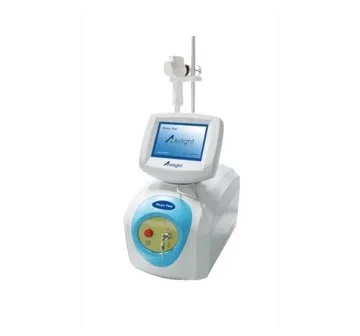
Pmise EF-01
Buying an EF-01 is the easy part. Running it well is what nobody puts in the quotation: anesthetic timing, the endpoint your technician scans toward, and how many faces the room can actually turn in a day.
What this platform does
This page is a working guide, not a spec sheet. The wavelength-and-output table sits in the panel above. What follows is how the EF-01 behaves once a technician has the handpiece in hand and a patient in the chair.
Short version: 1550nm chases water in the dermis, not melanin. That single fact shapes your whole operating routine. Pigment isn't the gate, so intake screening leans on scarring history, recent injectables and photosensitising medication rather than phototype. Nothing gets ablated either, so there's no open wound to dress and none of the crusting management your CF-01 CO2 fractional laser demands. You trade single-session drama for a course of visits. Price the package that way, and schedule the room that way.
Everything below is general operator education. It isn't medical advice. Every protocol call belongs to the licensed clinician running the device.
Technical detail
| Wavelength | 1550 nm (Er:glass) |
|---|---|
| Mode | Non-ablative fractional |
| Spot density | Adjustable (mild to aggressive) |
| Skin types | Fitzpatrick I to VI |
| Downtime | Minimal |
| Cooling | Integrated contact cooling |
| Warranty | 12 months, lifetime maintenance |
How it works
The half hour before you fire a single pulse
Intake first. Ask what the patient is currently having done, not only what they've had done. Filler sitting in the treatment field, botulinum toxin inside a week, e-light or RF inside a week, ablative resurfacing inside three months — each of those pushes the appointment back. Our device manuals also flag pregnancy, a history of hypertrophic scarring, and caution with photosensitive patients. Photograph front and both sides. Get consent signed. Boring, yes. It's also the part that saves you six months later.
Then the prep chain your technician should be able to run half asleep. Deep cleanse the field — a water-oxygen jet clears make-up and keratin debris in one pass — then blot the residual moisture off with sterile gauze, because a wet surface changes how the energy lands. Wipe the lens cone with 75% alcohol roughly ten minutes ahead and let it dry properly. Goggles on the patient. Topical lidocaine sits about 15 to 20 minutes. Don't over-anesthetise: that pinprick sensation is your live feedback channel, and you throw it away if the patient feels nothing at all.
Opening parameters and the endpoint you scan toward
New patient? Test low on the inner forearm, then start the face conservative and climb. Our protocol tables give sensible opening bands, all assuming topical anesthetic: periorbital and temple work sits in the mid-teens to mid-twenties mJ, general texture and pore work lands around 30 to 40, jawline and contour sculpting climbs toward the 50s, and atrophic acne scarring runs higher still with a smaller pattern area dropped over the depressed spots. Density is usually 12 x 12 points per cm2, stepping up to 24 x 24 when you want denser coverage per pass. Two to three scan rounds is typical. You stop when the field is lightly pink and the patient reports that tight, pins-and-needles feeling. Not before. Not much after.
Two things worth drilling into a new operator. At the same energy, a smaller spot goes deeper — so changing the cone changes the dose even when the number on screen hasn't moved. And a wider pulse interval buys thermal headroom, which means a calmer patient at the same nominal setting. Density, not energy, is the lever most tied to pigment trouble; Kaushik and Alexis made exactly that point in their 2017 evidence review of nonablative fractional resurfacing in skin of color. On a Fitzpatrick IV to VI face, test spot, keep the density low, and come back stronger next visit.
Applications and protocol
How many visits to sell, and how far apart
Never sell one session. Published trial work lands in the same territory as our own protocol sheets: Hedelund and colleagues treated atrophic acne scars with three monthly 1540nm nonablative fractional sessions in a randomized controlled trial with blinded evaluation, and measured texture improvement against untreated control sites on the same patient. Our internal treatment tables schedule roughly three sessions at three-week spacing for fine periorbital lines, three to six at three weeks for contour and general texture work, and around six sessions for atrophic scarring. Interesting wrinkle: our own documents disagree on scar spacing, one sheet saying seven to fourteen days and another saying three to four weeks. Err long if the skin is still pink.
Collagen keeps reorganising for weeks after the final pass. So the photograph that sells your next patient is the one taken months later, not the one at day seven. Say this at consult and you kill the "I don't see anything yet" phone call on day four.
Aftercare your technician hands over at the door
- Serum onto the field immediately after the last pass, while absorption is still elevated.
- Hands off for an hour. No foundation, no make-up, for 24 hours.
- Sunscreen, and mean it. A 2025 review in the journal Life found early broad-spectrum protection speeds recovery and reduces inflammation after light and laser facial work, with zinc oxide and titanium dioxide blockers the kindest option on freshly treated skin.
- Barrier care and hydration through the first week. Park the acids and retinoids.
- Our manuals also tell patients to skip spicy food and shellfish for the first couple of days. Take it or leave it, but it's in the sheet, and patients from some markets expect to be told.
Erythema and mild swelling are normal. The randomized trial cited above logged moderate pain, redness, oedema and crusting as ordinary consequences of nonablative fractional passes, so warn people at consult rather than fielding a frightened message that evening. Blistering, anything that looks like spreading infection, or pigment that isn't fading on schedule needs a clinician's eyes — not a reassuring text from reception.
Key advantages
What it actually costs you to run, week after week
No disposable tips. For anyone who's been burned by a consumable-locked platform, that's the headline. Your recurring spend is power, topical anesthetic, gauze and alcohol, post-care serum and sunscreen, and eventual lens cone servicing. Put that beside a cartridge-based device's cost per shot before you sign anything.
Throughput is the honest constraint. Our operation notes put a full face at roughly 1.3 to 2 hours once you count the 20-minute anesthetic soak. So the room does a handful of full-face cases a day, not a dozen. Regional work — periorbital only, a scar patch, a neck — moves far quicker, and stacking those between full-face bookings is how busy clinics keep the console earning. Two beds sharing one machine, with the anesthetic soaking on bed two while bed one is being scanned, is the cheapest capacity upgrade available to you.
Training curve, and where new operators stumble
Shorter than CO2. Longer than IPL. A technician who already runs energy devices picks up pattern, area and density quickly enough; the mechanical part isn't hard. Judgement takes longer — reading the endpoint, adjusting mid-session when tolerance shifts, knowing when a round is finished. Pair a new operator with a senior one for the first stretch of faces and don't let her set energy alone before that.
Room requirements are light. Air cooled, single-phase mains, no plumbing and no exhaust duct. What you do need: eyewear rated for 1550nm for everyone in the room (the goggles from your diode hair removal system are the wrong wavelength and protect nobody here), plus controlled access to the door. Our service team ships the document set with the unit.
Frequently asked questions
How many clients can one room realistically handle in a day?
Work backwards from chair time. Full face with anesthetic occupies a long slot, so you're booking a small number of those plus shorter regional cases around them. Most clinics that complain about poor utilisation are running one bed per console and letting the anesthetic soak eat the schedule. Move the soak to a second bed. That's a scheduling change, not a hardware purchase.
Do I screen darker skin types differently?
You screen the same way and you treat more cautiously. Water absorption ignores phototype, which is precisely why this platform reaches patients your Q-switched and IPL work can't safely serve. But density drives post-inflammatory hyperpigmentation risk more than energy does, per the evidence review noted earlier, so run a test spot, keep the first visit conservative, and stretch the interval if pigment shows up. Sunscreen compliance stops being a suggestion. Our skin resurfacing notes cover how this sits alongside the other resurfacing options in a clinic.
When does a case belong on the CO2 machine instead?
Deep ice-pick scarring and thick fibrotic tissue. Non-ablative columns build collagen over time; they don't remove much tissue. If a patient wants a large change and will accept genuine downtime, that's a CF-01 conversation. Mixed acne scar faces frequently get both across a single treatment plan — read our acne and acne scar page before you write one up.
What goes wrong most often in the first month of ownership?
Three things, roughly in order. Over-anesthetising, which blinds the operator to patient feedback and tempts her to push energy. Chasing a visible result inside one session instead of trusting the course. And forgetting the preheat delay at power-on, then deciding the machine is faulty. None of those are engineering faults. All three are training. For protocol questions, spare lens cones or operator training, talk to us.
References
- Hedelund L, Moreau KER, Beyer DM, Nymann P, Haedersdal M. Fractional nonablative 1,540-nm laser resurfacing of atrophic acne scars. A randomized controlled trial with blinded response evaluation. Lasers Med Sci. 2010;25(5):749-754.
- Kaushik SB, Alexis AF. Nonablative Fractional Laser Resurfacing in Skin of Color: Evidence-based Review. J Clin Aesthet Dermatol. 2017;10(6):51-67.
- Lee KWA, Chan LKW, Song JK, Lee CH, Kim J-H, Yi K-H. Importance of Using Sunscreen After Light or Laser Facial Treatment: A Literature Review. Life. 2025;15(9):1484.
Quote the Pmise EF-01.
Tell us your country and clinic type. We reply within 24 hours with technical detail, pricing and the spare-parts picture.