Diode Laser Machine for Hair Removal: What Wears Out
What a diode laser machine is (and what it is not)
A diode laser machine for hair removal is a professional device, not the engraver or the at-home wand that shares the search term. Say a clinic owner asks me whether the unit she's pricing is the same thing as that cheap "diode laser machine" she saw online. It isn't. What she's buying, if the hardware is honest, is laser diode bars inside a handpiece, firing 808nm light at the follicle.
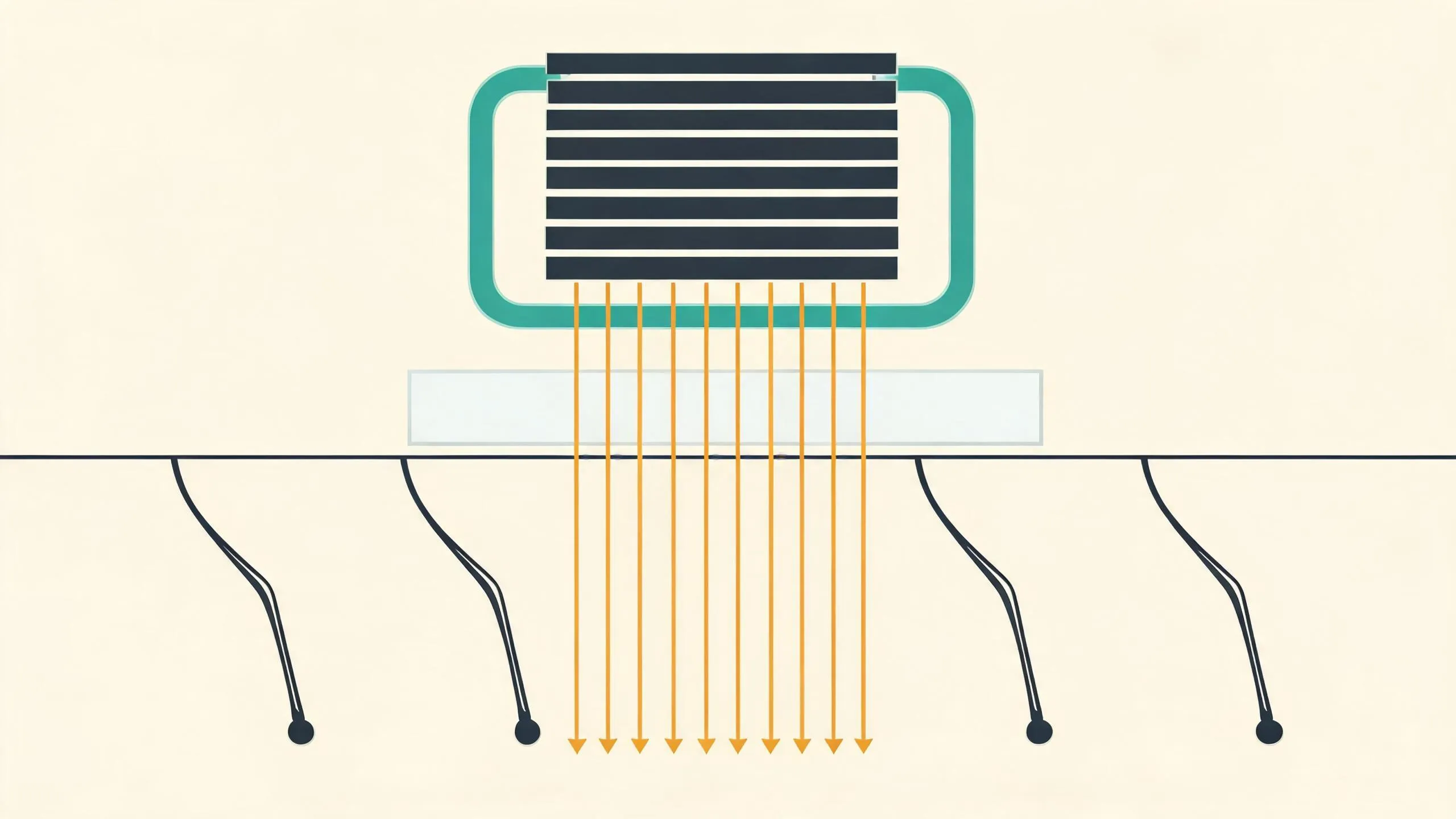
Start at the light source. A diode system has no flashlamp and no crystal rod to pump. Semiconductor bars do the work directly, so the handpiece is a solid-state device rather than a lamp cavity wrapped in a filter. Fewer consumables to schedule, and one assembly carrying the load.
Some physics, kept short. Melanin in the hair shaft and follicle absorbs near-infrared light, and that absorbed energy becomes heat. Hold enough of it in the follicle for long enough and you damage the structures that regrow hair. That's selective photothermolysis. The honest name for the result is permanent hair reduction, not removal.
Now the boundaries. Pmise supplies professional aesthetic laser and energy-based equipment to clinics, medical spas and distributors. We don't supply alexandrite lasers, picosecond lasers, erbium YAG (2940nm) lasers, electrolysis, microdermabrasion or skin analysers. You can buy those elsewhere, and plenty of suppliers will bundle them. Just don't attribute them to us.
Why the handpiece is the part that ages
Diode bars are stacked in the handpiece, not buried in the console. That one design choice decides what wears first. The console holds the power supply, the control board and the chiller. The handpiece holds the light, the cooling and the skin interface. Guess which one does the work.
On the DL-07, a sapphire window sits over a closed water loop inside the handpiece. Sapphire passes 808nm light and pulls heat off the skin surface at the same time. Water behind it carries that heat back to the chiller. Two jobs, one assembly, thousands of pulses.
What that means at the console
Handpiece condition and cooling performance drive consistency more than anything in the console does. A tired handpiece doesn't fail dramatically. It drifts. Fluence wanders, the sapphire runs warmer against the client's skin, sessions stretch out, and your technician starts compensating with technique instead of reporting the fault. That's how a machine quietly stops paying for itself.
So ask any supplier how the handpiece is serviced, and whether the diode stack can be replaced on its own or the whole handle goes back. Ask how the bars are cooled. Ask for a documented service path rather than a phone number. Nobody can quote you a reliable figure for that without knowing how hard you run the machine, and any supplier who does is guessing. The answer still shapes your cost of ownership more than the sticker on the console. The DL-07 operating guide covers the day-to-day side.
Single-wavelength 808nm versus multi-wavelength handpieces
808nm is the workhorse wavelength for hair reduction, and our DL-07 is a single-wavelength 808nm diode laser. That's the whole wavelength spec. It's deliberate.
Multi-wavelength handpieces, often sold as a 3-in-1 diode laser hair removal machine, stack two or three emitters in one housing: typically 755nm, 808nm and 1064nm. The intent is easy to follow. Shorter wavelengths are absorbed more strongly by melanin near the surface; longer ones travel deeper. The extra wavelengths are meant to shift target depth and chromophore preference. Whether that helps your caseload is a question I'd answer with your booking list, not a brochure.
One comparative study of 31 adults with skin types I-IV put a continuously linear-scanning 808nm diode against a 755nm alexandrite over six treatments at four-week intervals. Hair clearance after the sixth session came out at 72.16% for the diode side and 71.30% for the alexandrite side, and it held at 18 months (PubMed). Roughly the same result from two different wavelengths, which is worth remembering the next time a sales sheet leans on emitter count.
What extra wavelengths do add is complexity: alignment work, cooling load and more failure points inside the same handle. A 3-in-1 handpiece is also heavier to hold all day. If most of your clients sit mid-range on the Fitzpatrick scale, a clean single-wavelength machine is the simpler bet. If you book a lot of darker phototypes, read our notes on treating tanned and darker skin first, because that's where wavelength and technique earn their keep. One small study of ten women with skin types IV-VI ran an 808nm diode at 8-9 J/cm2 with 36ms pulses and integrated sapphire cooling across three sessions, and reported mean hair reduction of 57.9% in the underarm group and 56.7% in the chin group, with side effects that were minimal and transient (PubMed).
Plainly: Pmise supplies the DL-07 at 808nm and doesn't offer multi-wavelength diode handpieces. For the alexandrite category, and why we stay out of it, see our notes on the alexandrite laser hair removal machine.
Sliding versus stamping: what the machine must support
Two techniques, two sets of demands on the hardware.
Sliding means the handpiece never stops moving. Overlap only stays even if the repetition rate is high enough, which is why 808nm diodes with fast rep rates suit large areas. Our published DL-07 specification puts repetition rate at up to 10Hz. Stamping is the reverse: place the spot, fire, lift, move, fire. That needs repeatable pulse delivery and an operator who can keep track of where they've already been. Legs slide. Small patches get stamped.
Energy, pulse width, repetition rate
Three controls, and operators mix up what each one does. Energy, or fluence, sets how much light lands per square centimetre. Pulse width is how long each pulse lasts, which decides how much heat diffuses away while the shot is still running. Repetition rate is pulses per second, and it sets your hand speed.
Our device documentation starts low. As usual, it says, use 10Hz with a 20ms duration and start the power at 33%, then raise it according to the client's feeling while moving the handle quickly. That last clause does a lot of work. Slow the hand down and your technician has just raised the dose per unit area without touching a setting.
There's an interlock worth asking about. Pulse width and frequency are tied together in our documentation: 5-20ms allows the full 1-10Hz, 25-40ms allows 1-5Hz, 45-100ms allows 1-2Hz, and anything over 100ms caps you at 1Hz. The DL-07 pulse width range is 5-200ms, so there's room on both sides. Long pulses buy a gentler, slower pass. Short ones let you move. Pick the technique first, then let the machine's limits shape the numbers. Our session walkthrough goes deeper into the floor work.
| Requirement | Sliding (in motion) | Stamping (static) |
|---|---|---|
| Repetition rate | High enough to keep overlap even as the handpiece moves | Low; one pulse per placement |
| Pulse width | Short durations, since higher rates are locked to them | Free to run longer durations |
| Fluence per pulse | Lower, because overlap raises the cumulative dose | Higher per pulse, with no overlap |
| What the operator must do well | Hold hand speed and pressure steady | Place accurately and remember the grid |
| What goes wrong | Slowing mid-pass, stacking heat | Re-firing the same spot, missing patches |
| Best fit | Legs, backs, large areas | Lip, chin, underarm, contoured areas |
Cooling, water quality and the no-fire faults
Sapphire contact cooling over a closed water loop is the cooling path on the DL-07, and the loop has to be running and stable before the first pulse. Our device documentation is specific about the order. Switch on the cooling machine first, wait 5-8 minutes until both temperatures read 18 degrees C, then start the machine. The documented operating window is 18-26 degrees C.
Why the ritual? A cold sapphire window against skin does two jobs: comfort for the client and protection for the epidermis. Fire while the loop is still settling and you're loading the bars before the chiller has caught up.
The no-fire call
When the machine won't fire, our fault manual has you check the water side first. The interface reports a cluster of related messages: substandard water quality, low water level, cold water terminal without current, high temperature, communication failure. If one of those is on screen, the machine is telling you what it found, so don't keep firing at it.
First response, in order. Check the reservoir level. Check water quality, because conductivity is monitored internally and dirty water trips the warning. Confirm the chiller is running and has had time to settle. Check that the handpiece connector is seated. Then escalate to whoever services your unit. A maintenance schedule is what keeps this quiet, and there's a practical version of that in our daily machine care routine.
What to check before you buy a diode laser machine
Imagine you're choosing between two consoles that look identical on paper. The differences that matter usually aren't on the paper.
Cooling design first. Ask whether the water circuit is a genuine closed loop, whether the chiller can be serviced, and what operating temperature window the supplier documents. Ours is 18-26 degrees C and we write it down. A supplier who can't name the window probably hasn't measured it.
Then the handpiece. Ask whether it can be serviced or must be replaced as a unit, and how the diode bars are cooled. Then ask what the troubleshooting path actually looks like when the interface throws a water-quality warning at 6pm on a Friday.
Then training and documentation. The handover should include parameter starting points and a fault reference. Ask to see the parameter sheet before you pay.
Then laser safety, which in most markets is your duty rather than your supplier's. The Z136.1 standard puts the Laser Safety Officer in charge of evaluating laser hazards and making sure control measures are implemented and maintained (LIA). Check what your own regulator requires: a nominated officer, a controlled area, signage, eye protection, training records. We don't certify any of that, and no equipment supplier can carry it for you.
Buyer checklist
- Closed-loop cooling with a documented operating temperature window
- A stated handpiece service path: replaceable diode stack or full replacement, and how the bars are cooled
- Parameter starting points supplied in writing
- A named troubleshooting route and spares for the handpiece and chiller
- Local laser safety duties identified before the first client
Cost drivers now, since price is what everyone asks and nobody can quote it honestly in a blog post. What moves the number is handpiece design and serviceability, cooling architecture, after-sales support, and how many wavelengths sit in the handle. Two machines at the same price can land years apart on total cost. Ask for the service path in writing and compare that instead.
Diode laser versus IPL (short)
A diode emits one coherent wavelength, so melanin absorption is reasonably selective and the light reaches a useful depth without much filtering. IPL fires a broad spectrum through cut filters, which means more energy lands in tissue you didn't target, and the operator leans harder on cooling and pulse shaping to compensate. Diode tends to be faster on large areas. IPL is often more forgiving on light, fine hair. For the full comparison, see our notes on diode laser hair removal.
Frequently asked questions
What is a diode laser machine used for?
In professional aesthetics, it's used for hair reduction on the face and body, and 808nm is the wavelength our DL-07 uses. Laser diode bars in the handpiece emit near-infrared light that melanin in the hair follicle absorbs, and the resulting heat damages the follicle over a course of sessions. The accurate phrase for that result is permanent hair reduction, not permanent removal. The same hardware doesn't do pigmentation, vascular work or skin resurfacing; those need different wavelengths and pulse structures. Diode lasers also exist in industrial settings for cutting and engraving, which is a completely different machine and not what a clinic buys.
Is a diode laser hair removal machine good?
For hair reduction on large areas across a range of skin types, yes, it's a mature and well-understood option. Regrowth slows over a course of sessions rather than stopping after one, and results vary with skin type, hair colour, the settings used and whether clients actually attend their appointments. Published work on the wavelength is generally encouraging, though it describes specific devices and protocols rather than your caseload. Any clinic promising a fixed percentage before assessing a client is guessing.
What are the disadvantages of a diode laser machine?
Four honest ones. The handpiece carries the optical load, so it's the assembly that ages first and the one you'll end up servicing. Cooling matters more than most buyers expect: water quality, water level and chiller faults are the first things our fault manual checks when the machine won't fire, and the water loop has to be stable before the first pulse. Comfort is a real variable, and in comparative work more patients reported pain with diode than with alexandrite, though treatment was rated tolerable. And the machine is only as good as its operator, which means documented parameter starting points and real training, not a one-off demo.
How much does a diode laser machine cost?
Nobody being straight with you will put a figure in a blog post, because the price depends on what you actually buy. The drivers are the handpiece (how many diode bars, how many wavelengths, whether the stack is serviceable or the whole handle gets replaced), the cooling architecture, the console's power supply and control electronics, and the scope of the training and after-sales support included. Two machines quoted at the same number can sit years apart on total cost of ownership. Ask every supplier for the service path, spare parts availability and training scope in writing, then compare those alongside the price.
References
More guides
The Nd:YAG Hair Removal Machine: What Changes When You Move to 1064 nm
A practical operating guide for the long-pulse 1064nm Nd:YAG hair removal machine: who to treat, how to set it, and how to keep it profitable alongsid
ReadChoosing a Professional Hair Removal Machine by Clinic Profile, Not by Spec Sheet
Before you compare joules and spot sizes, fix your clinic profile. Here's how solo salons, chains, med spas, and upgraded home studios should choose d
ReadAxilla and Bikini Line: Small Fields, Most of Your Bookings
Small fields drive most bookings. Here's how to treat axilla and bikini line safely and profitably, covering positioning, hygiene, density, and the ps
ReadAsk us the awkward question.
Spare parts, consumable cost, training time - tell us what you need to know before you buy.